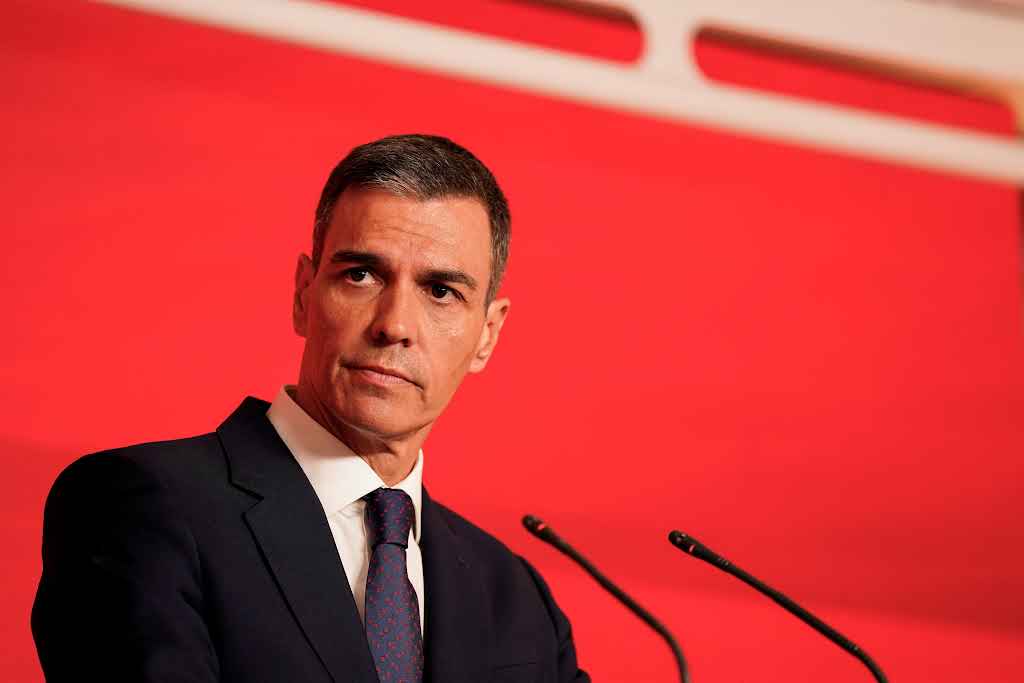
Today the whole world is discovering Pedro Sánchez, the Spanish socialist leader who heads a left-wing coalition government. His “no to war” in Iran resonates as a powerful warning signal in the face of the deadly danger threatening the system of collective security established in 1945. The United Nations—whose true meaning was an “organization of nations united against fascism”—was meant to prevent any new war.
This “no” is also a resounding rejection of Trumpism. Pedro Sánchez is the only European head of government to oppose head-on the war sought by Donald Trump, by refusing to allow the United States Air Force to use American bases located in Andalusia. By contrast, France and United Kingdom have granted the U.S. military access to their bases as American aircraft methodically bomb Iran, in disregard of international law. This refusal is all the more striking given that Trump’s war initiative appears wholly reckless: a war against a country with a millennia-old history could lead the world toward general chaos.
Pedro Sánchez stands within the tradition of Spanish progressives. His “no to war” reflects a deep political culture of rejecting war in the country’s history. The founding event of this culture was the deliberate and systematic massacre of civilians in the small Basque town of Guernica by fascist aviation in 1937. This bombing marked a world first and a historical turning point: it inaugurated a new era in which the mass killing of civilians became a strategic instrument of pressure. In the context of the Spanish Civil War—which pitted democrats and progressives on one side against the union of right-wing forces around General Francisco Franco, supported by fascist states—Guernica became a historic symbol of freedom.
This practice of Nazi aviation would be repeated in May–June 1940 in France, when columns of civilians fleeing the German advance were bombed and machine-gunned on the roads. In 1937, by painting Guernica, Picasso created a work of art that was a universal denunciation of barbarism. At the time, part of the right-wing press—among them Le Figaro —echoed fascist propaganda accusing “the Reds” of being responsible for the massacre. By contrast, the newspaper L’Humanité reported the actual facts.
On the Palestinian question, Pedro Sánchez has adopted one of the most openly opposed positions in the Western world to that of the Israeli far-right government. He was among the first European leaders to recognize the State of Palestine and the only one to impose a genuine embargo on arms sales to Israel. He is also the only Western head of government to refer to the existence of a “genocide in Gaza.” In Spain, a recent poll indicates that more than 80 percent of Spaniards share his view. Pedro Sánchez can therefore rely on very strong public support. But of course, he condemns the terrorist massacres carried out by Hamas on October 7 and defends Israel’s right to exist without threat.
A Coalition of All the Left
In Spain, as elsewhere, foreign policy is a powerful marker of the confrontation between a left-wing bloc and a far-right bloc, strengthened by the rallying of part of the traditional right. As soon as he took office as prime minister, Sánchez declared that he wanted to build “a wall against the right and the far right.”
Although he has not had a majority to pass his budget since 2023, he has nevertheless succeeded — thanks to his rhetorical skills, his sense of negotiation, and his art of compromise — in building a coalition that unites all the forces of the left, including the radical left. He has also secured the support of Basque and Catalan pro-independence parties. This coalition was born from what is known as a “constructive vote of no confidence,” a feature specific to the Spanish system. Unlike in France, a motion of censure can only be introduced by a coalition that already possesses a governing program.
The budget is therefore renewed from year to year, with adjustments that make it possible to pursue a left-wing policy supporting domestic demand. Since 2023 the minimum wage has increased by 60 percent, reaching €1,200 in a country where the cost of living remains lower than in France. Pedro Sánchez is thus pursuing a policy of transformation rather than simple management. The Spanish Socialist Party clearly states that it does not follow a purely social-democratic management model. The left-wing markers are strong: priority to renewable energy,assertive feminism, and clearly defined social policies.
This policy of transformation has also been an economic success. Spain today enjoys the strongest growth in the European Union, exceeding 3 percent. This growth is based on domestic demand, the development of tourism, and significant but controlled labor immigration. Pedro Sánchez’s policy remains pragmatic but grounded in clearly affirmed left-wing values. It is welcomed by rating agencies. Strong growth also allows for a significant reduction in public debt. A comparable phenomenon occurred in France under the left-wing coalition government led by Lionel Jospin between 1998 and 2002.
This has not prevented the European right from criticizing Pedro Sánchez’s policies. Yet the present moment reveals the limits of the supply-side and austerity policies it advocates, at a time when the central issue remains the purchasing power of the middle and working classes.
Eric Djabiev