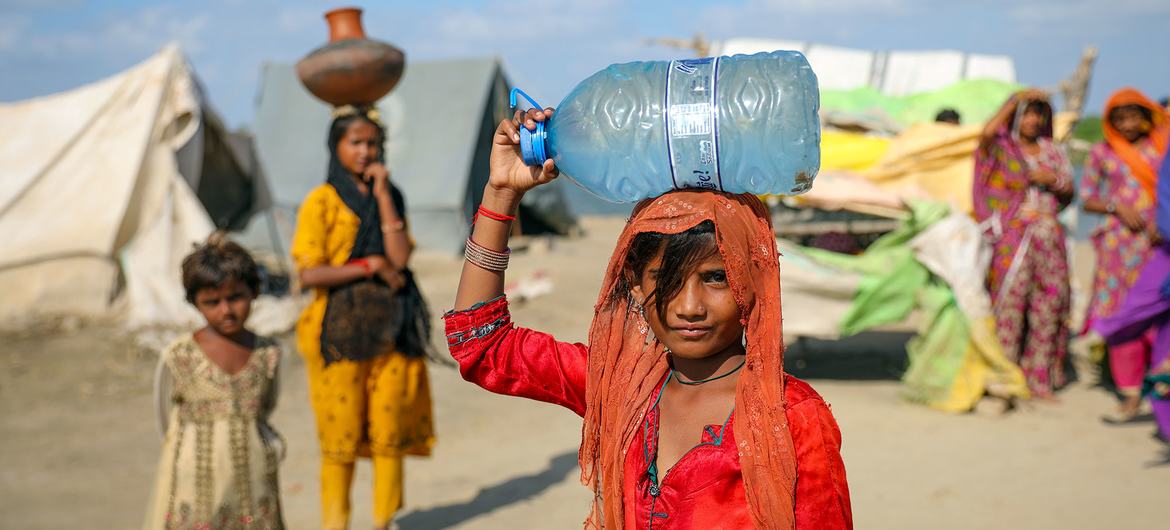
In March 2023, the United Nations Water Conference brought together some 10,000 representatives of UN member states, NGOs and businesses in New York, and called for the appointment of a UN Special Envoy on Water* to address the urgent need to ensure greater respect for the human right to this essential resource.
This imperative is underpinned by the UN General Assembly resolution adopted on 28 July 2010, recognizing “the right to safe and clean drinking water and sanitation as a human right that is essential for the full enjoyment of life and all human rights”. Indeed, water, one of the Earth’s natural resources, is not just another commodity, and given its vital importance to humankind, it is only fitting that it should be considered a global public good, a common good.
At a time of global warming, this vital resource known as ‘blue gold’ is all the more crucial. A few figures highlighting the drastic consequences of water scarcity illustrate just how fundamental it is:
• 2.2 billion people do not have access to safely managed drinking water services and have to drink contaminated water • More than half the world’s population – 4.2 billion people – are without safely managed sanitation services • Over 297,000 children under the age of five still die every year from diarrheal diseases caused by unsafe drinking water • Almost 90 per cent of natural disasters are water-related (floods, cyclones, tornadoes, drought, etc.) • 80 per cent of the world’s wastewater is discharged untreated into the environment.
The UN reflects the gravity of the situation, reporting that over 842,000 people in low- and middle-income countries die as a result of inadequate access to safe water every year. The problems linked to water are further exacerbated by the high level of water wastage in the countries of the North.
Similarly, when it comes to seawater, pollution is dramatically affecting the water on Earth: a ‘garbage patch’ or ‘plastic continent’ is floating in the Pacific, and in August 2023, Japan began discharging contaminated water from the Fukushima disaster into the sea.
Alongside these human and environmental challenges lies the threat of ‘water wars’. Water has become a key weapon and major stake in current geopolitical confrontations: in Ukraine, the destruction of the Kakhovka dam in early June 2023 led to severe flooding and the evacuation of more than 8,000 people; Egypt is considering “the use of force, including air strikes, against the Grand Renaissance Dam being built by Ethiopia on the Blue Nile”, the waters of the Indus and Brahmaputra rivers are disputed by China, India and Pakistan; and in the Middle East, Turkey is looking to control the great rivers of Mesopotamia.
Water is also a source of conflict and tension within states, sometimes leading to violent confrontation, from Colombia to South Africa, including France, where, on 25 March 2023, more than 200 people were injured in clashes with the police during demonstrations against the construction, in Sainte-Soline, of vast reservoirs or ‘mega-basins’ for agriculture.
UN action
The 2010 UN resolution, which recognizes the right to water as essential to the realization of all human rights, is particularly important in this respect. The text specifies a minimum of 50 and 100 liters of water per person per day, at a cost that must be affordable, that is, less than three per cent of household income. It also specifies that all families must have access to a water source within one kilometer of their home, and that the time taken to collect this water should not exceed 30 minutes.
Five years later, under the 17 ‘Sustainable Development Goals’ (SDGs) proclaimed by the UN in 2015, goal 6 aims to ensure access to and the sustainable management of water and sanitation for all.
But will these declarations remain merely declaratory in a world where they have no binding force and the UN has no power to sanction?
Despite not being able to enforce its resolutions by making them legally binding, the action taken by the UN has nevertheless been useful, all the more so given its long-term perspective, with the organization having begun its work almost 80 years ago. The action of the UN and its agencies on the issue of water dates back to the 1970s, when ecological and environmental concerns were coming to the fore, with the holding of the UN Water Conference in 1977, followed by the International Conference on Water and the Environment in 1992, the year of the Rio Earth Summit.
UNESCO was even a pioneer, launching research programmes on ‘arid zones’ and ‘wetlands’ in the 1950s, then creating the International Oceanographic Commission (IOC) and launching an Intergovernmental Hydrological Programme. Its first director-general, Julian Huxley (1946-1948), was a scientist with a keen concern for the conservation of nature.
The global water conference held by the UN in March 2023, the first on this subject for 40 years, produced a strong albeit not legally binding text, the Water Action Agenda, which covers all the (over 700) voluntary commitments regarding water and will monitor their progress.
The European Union (EU), for example, has pledged to “support the access of 70 million individuals to an improved drinking water source and/or sanitation facility” by 2030. The EU has also pledged to support its member states “with funding of €20 million to accelerate the deployment of wastewater surveillance”. Another example is the commitment made by French multinational Danone to launch a blended fund “to give daily safe water access to 30 million people in need”. In total, US$300 billion has been pledged to support the Water Action Agenda.
This conference is highly significant in that, as journalist Akram Belkaïd points out in Le Monde diplomatique, unlike the oceans, which are now protected by a global treaty, adopted in March, there is no major text governing the use, sharing and conservation of freshwater. It is, therefore, a step towards achieving this goal. As the conference was taking place, the UN published its World Water Development Report for 2023.
Water multinationals and the defense of their financial interests
Behind this rhetoric, however, lies the reality that private sector interests are gaining a growing foothold within the UN. This incursion of the private sector into the inner workings of the UN dates back to the 2000s, under the mandate of Kofi Annan. This UN secretary-general brought about the involvement of multinationals in UN debates through the Global Compact, which he set up. But the water multinationals, often listed on the stock exchange, from French firms Suez and Veolia to American Water, Thames Water, Brazil’s Sabesp and Switzerland’s Nestlé, are strongly influencing the discussions and the direction of the texts adopted.
As heterodox economist Sylvain Leder points out, “in 1992, at the United Nations Water Conference in Dublin, […] this resource was, for the first time, officially recognized, internationally, as an economic good”.
This has led to the establishment of a true oligarchy or “global high command for water”, in the words of the economist and political scientist Riccardo Petrella. As Leder explains, this oligarchy is “headed by the World Bank, which was behind the creation in 1996 of the World Water Council, run at the time by top executives from multinationals such as Suez and Vivendi (now Veolia) and headquartered in Marseille. The Council’s mission is to define a global vision for this resource within a liberal framework. The operational dimension is covered by the Global Water Partnership, set up the same year to promote public-private partnerships.”
Freshwater, which represents a market worth over €600 billion, is increasingly central to the economic stakes of the 21st century. And there is a tug-of-war within the Organization between the humanist imperatives of the ‘right to water’ and the logic of predatory profit and the commodification of all natural resources.
The UN therefore has a duty to free itself from private sector interests and the powerful lobbies associated with them, and to take a firm and unambiguous stand for the right to water, in the spirit of the “economic and social rights” proclaimed by the organization in 1966.
Chloé Maurel
First published on Equal Times, 7 September 2023