In mid-March, Romania, together with Austria, Croatia, Greece, Italy, Bulgaria, the Czech Republic, Hungary, Poland, and Slovakia, signed a letter addressed to the President of the European Commission, Ursula von der Leyen, and to the President of the Council, António Costa, calling for an urgent revision of the deadlines set by the energy transition plan. This issue, seemingly highly technical, brings together a group of states with specific interests: some display a clear hostility toward European institutions in their current form (the most extreme case being that of Viktor Orbán, who has based his electoral campaign on AI-generated videos portraying the EU and Ukraine as public enemies); others have direct economic interests, linked to the nature of their energy consumption or to infrastructure projects, which are largely incompatible with the timelines adopted at the European level.
This comes in the context of an Israeli-American war against Iran, which is generating structural disruptions in global oil and gas supply and which, according to several European and Romanian analyses, makes the case for a European renewable energy strategy rather than fossil fuel dependency. At the same time, amid the Russo-Ukrainian border war that has been ongoing for four years, Romania appears to be basing its entire “energy sovereignty” strategy on the Neptun Deep project, located not far from the maritime front line.
Last March, Romania was invited by France to participate in the European nuclear umbrella initiative. The presidential administration has still not given a clear response (after several days of extremely evasive communication in early March). In contrast, the response to Donald Trump’s invitation on February 19 to participate in the Peace Committee was much quicker: an initiative that closely resembled a pyramid scheme for the personal benefit of the American president, who, in any case, ignored the international cooperation structures to which Romania belongs and where President Dan attended as an “observer.” Since Donald Trump’s election to the White House, pro-Putin reactionaries have finally had the opportunity to reconcile the apparent cognitive dissonance of their dual proximity to Russia and the United States. The Slovak Prime Minister has thus, like any self-respecting reactionary, carefully maintained ties with both sides. Last January, he was invited to Mar-a-Lago, where he assured Trump that he was not “a Brussels parrot.”
Fico’s visit, however, is consistent with longer-standing projects, exemplified by Romania’s participation in April 2025, through acting President Ilie Bolojan, at the Three Seas Conference. The general context in the region reflects a gradual strengthening of the Central European Eurosceptic bloc, structured around the former Visegrád Group. Thirty-five years after its creation, the group appears to base its political unity on a balance between closeness to the Kremlin and to Washington.
Even Poland, hitherto a pro-Ukrainian stronghold, is aligning with this trend following the inauguration of President Karol Nawrocki. On March 24, after a vehement speech against Vladimir Putin, President Nawrocki traveled to Budapest to publicly express his support for Prime Minister Viktor Orbán, then in the midst of his electoral campaign for the April 12 elections. Observers noted that the Eurosceptic line dominates the Polish president’s strategic alliance choices.
In the Czech Republic, the autumn 2025 elections also marked a shift toward a conservative, Eurosceptic right. Prime Minister Andrej Babiš’s ANO party is allied with Hungary’s ruling Fidesz party of Viktor Orbán within the Patriots for Europe coalition, which brings together far-right parties. A few days ago, protests took place in the Czech Republic against a law regulating NGO funding according to a model its opponents denounce as Russian-inspired.
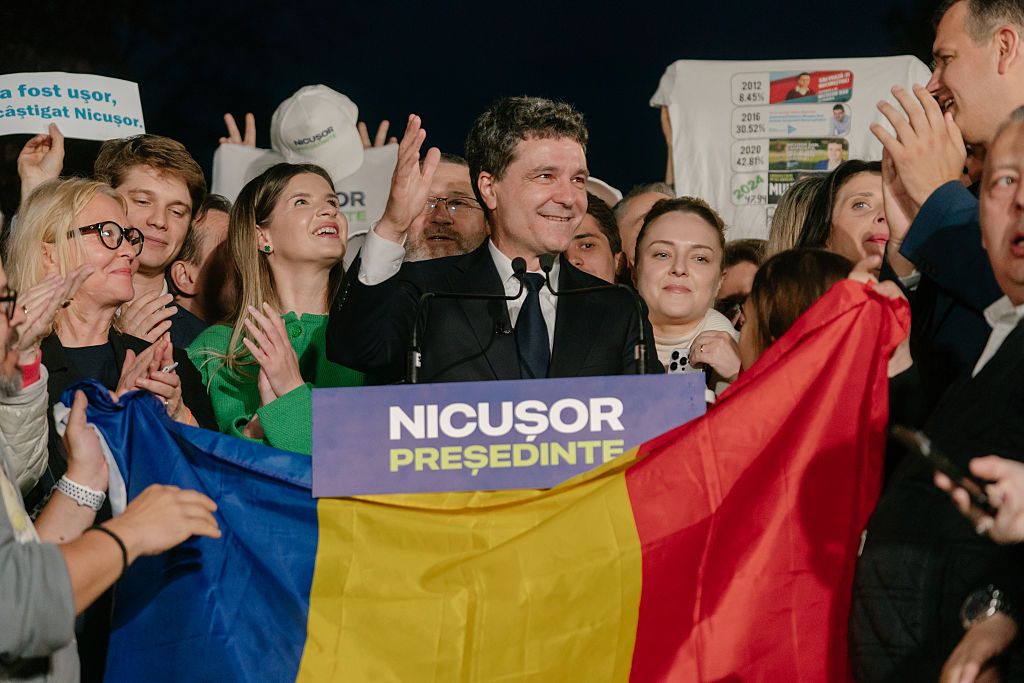
Nicușor Dan won the presidential election on a “pro-European” platform, and amid the turmoil of the campaign nearly a year ago, there was little opportunity to analyze in depth what this concept would look like under the vision of the new government. Eleven months later, an assessment can already be made, both in terms of foreign policy and regarding the major directions of domestic and economic policy outlined by the presidential candidate in his proposals.
What emerges suggests a “Europe of Nations”’ model: a euphemism long used by a much older Eurosceptic political project, but initiated through an American-Hungarian co-production discussed in March 2024 at Mar-a-Lago during a visit by Viktor Orbán and integrated into Project 2025.