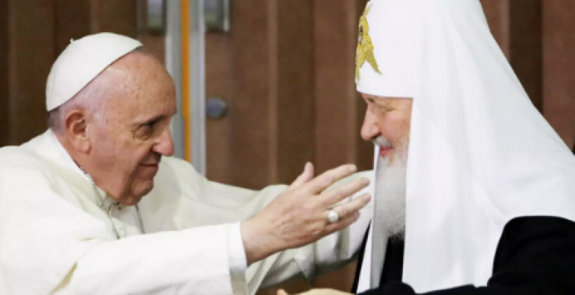
Contrary to the hopes of those who spreading rumors about his possible resignation, Pope Francis died in action. The way one could expect from a man such as he was, a fighter steadfast in his convictions in defense of the common good, of justice, and of the poorest on earth, he feared nothing and no one.
Never afraid of expressing his political views – sharp and lapidarily succinct, as in the case of “NATO barking at Russia” – he was endowed with clear-sightedness that professional historians or literary scholars have rarely been able to match. So that it is no coincidence that the Palestinian people—victims of the most brutal and deliberate massacre of this century—have always considered him a faithful friend, whose evening phone calls to the catholic Parish in Gaza were nothing less than an unceasing appeal to humanity to put an end to the ongoing martyrdom. Such as was his latest walkabout.
It would indeed be difficult not to see his final public appearance before the crowd—an outing which physicians had advised against – as a a voluntary gesture imbued with a specific meaning. An action carried out in full awareness that he was near death; and undertaken in order to offer an ultimate gift to the faithful, and a legacy to all humanity. To those “others” to whom, as the Dalai Lama said, he devoted himself entirely throughout his life. And to whom he left— in his final address, which he did not have the physical strength to deliver personally— the teaching to always pursue, in their social and political commitment, “freedom of thought and expression.”
A teaching, this last one, that would leave speechless those who fail to see how Christianity is the very essence of Western civilization, even when it expresses itself through the “revolutionary” thinkers of the enlightenment, and of the 19th and 20th centuries. A gesture of fully conscious sacrifice, that confirmed and completed a lifetime’s work.
One that, in turn, fully explains why, in recent times, his word—the word of the Pope—has had a resonance powerful such as none of his predecessors ever achieved. And an impact such as significant even beyond the Catholic sphere; within the global, multicultural, and multireligious society of the twenty-first century.
In a world where weapons have reached unimaginable heights of destructive power, to the point of raising fears that they may slip beyond human control, he not only consistently preached against war. But also took concrete and practical action in order to promote negotiation, dialogue and mutual understanding – sometimes with even greater dedication than when seeking to secure the reluctant and half-hearted signatures of politicians at the bottom of a peace treaty. So that from him seemed to emanate the conviction that, given the frailty of the human race, to avoid conflicts is nearly impossible.
Still, all this did not imply that clashes, rivalries, and even hatreds – as inevitable as they are – must necessarily turn into war. His visible awareness of the fact that avoidance of conflicts is utterly difficul, given the limits of the human race, was not out of indifference toward those who suffer. On the contrary, Pope Francis’ lifetime is marked by countless signs of being personally wounded by a cruel phenomenon – the globalization of indifference – atrociously widespread in the societies of the early twenty-first century. In spite of the fact that, unlike in the past, today’s adult generations have at their disposal all possible means to become aware of the misfortunes of others, even of distant peoples scattered across the globe and speaking mutually incomprehensible languages.
Pope Francis therefore always showed a keen awareness that the opposite of war and violence cannot be a peace that accepts injustice. An awareness that the opposite of war is not simply the absence of violent confrontation between human beings, or between the instruments of death they create. Rather, the opposite of war lies in dialogue and negotiation, inspired by the Christian spirit of compassion, and aimed at achieving mutual understanding.
It is easy to imagine, of course, how colossal the task becomes – when starting from such an approach – of being the most important spiritual leader in the world, not only within the framework of relations among peoples, but also within the Church itself. It is therefore no coincidence that he had – and even today, after his departure, more than ever continues to have – ideological enemies within the Catholic world, or among those who – sometimes unaware that they are verging on blasphemy - proclaim themselves as such. One of them, moreover—and among the most well-known—is none other than the Vice President of the United States, the last person he generously received on the eve of his passing.
Future historians will indeed have an easier task than his contemporaries in assessing the good he did for the Church and for society. For now, however, those who have ventured a judgment have only been able to write that: “While remaining a social conservative beneath the humble image of a parish priest, Pope Francis broke the mold, showing a greater willingness to take risks than his predecessors. He visited more than sixty countries, including some of the poorest in the world, as well as others reflecting his commitment to interreligious dialogue. He offered a consistent voice of compassion and an ethical framework for addressing issues of poverty, climate change, and social marginalization.” (Brian Casey)
Others have written that he was “a highly intelligent leader who understood the limits, complexities, and challenges of operating within an ancient institution such as the Catholic Church. And his appointments reflected this awareness. Francis was a man of firm and unshakable faith. He was deeply aware of his own mortality and legacy, at a time when the world was entering an era of climate crisis and growing authoritarianism, lacking an intellectual framework capable of overcoming these dangers and projecting itself toward a healthier and more progressive future.” (Simón Cazal)
Most of his contemporaries can, in the end, only think that we are faced with the legacy of a giant. And that – if we dare to say – it is up to all of us to carry forward his message. Without forgetting, however, that the very idea of what it means to be Christian, as it emanated from him, poses to each of us the extremely hard question of whether we truly have large enough shoulders to bear the dignity of baptism.
Giuseppe Sacco