We do not know how the Iranian tragedy will end. We do not know what Benjamin Netanyahu —whom we have come to recognise as the true global master — has in mind, nor what Trump is prepared to concede to him under the pretext of the Strait of Hormuz and the brutality of the ayatollahs’ regime.
The apocalypse, deferred by barely a fortnight, seems perpetually on the verge of eruption, sustained by a false truce that, in the absence of any substantive negotiation, presages a global equilibrium founded on terror.
We also doubt that the current occupant of the White House is truly the sociopath incapable of reason and volition that certain observers maintain. We are more inclined to believe that the notorious Epstein Files — replete with information that has evidently not yet been made public and perhaps must not be — play apart in his decisions. It is from this source, as other observers maliciously suggest, that one of the reasons for his near-total political subjugation to the Israeli prime minister may derive.
The sole certainty, in a landscape so bleak, is that we are dancing on the edge of the abyss: the most powerful man in the world entrusts to Truth — the social network he himself founded — delirious musings and threats of total annihilation capable of crashing stock markets and undermining the already fragile cohesion of the Western order, while the Tehran regime, far from weakening, has been strengthened by the concerted actions of Trump and Netanyahu. Had the tycoon ever read a book in his life, he would know that a multi-millennial civilisation such as Iran’s cannot be dismantled overnight: not even nuclear weaponry would suffice — on the contrary, it would provoke an uprising across the entire Arab world with consequences beyond calculation. Noris it to be excluded, in this regard, that the near-symbolic rapport which had developed with Saudi Arabia and the other emerging Gulf powers, built on oil and commercial interest, may eventually unravel over the longer term. If the fate of Gaza and the Palestinian people concerns almost no one, the Persians are geopolitically of an entirely different order. By virtue of their history, prestige, and demographic weight, we stand before a middle power — a regional actor inherently capable of assuming a hegemonic role. Israel’s fear of nuclear arms in the hands of the ayatollahs is not unfounded, and it cannot be excluded that this outcome may be reached in the relentless escalation we are witnessing.
We would add that Trump and his associates lack another dimension that, unfortunately for them, cannot be purchased: a knowledge of Middle Eastern character. Trump is, in effect, a television personality convinced he is still hosting an episode of The Apprentice, believing it sufficient to shout “You’re fired!” in order to dismiss unwanted interlocutors. The Persians, like the Chinese and many peoples settled to the East, have time on their side — time that flows inexorably in their favour. Not being democracies, at least not in the sense that we in the West understand the term, they are unburdened by the calculus of midterm elections and have no public opinion to which they must answer. They have always, moreover, rejected our frenzy and our obsession with success, even as they have — as in the Chinese case — embraced the logic of a social market economy. They are, in short, capable of steering any negotiation to their own advantage, as Putin is demonstrating with Ukraine, exploiting his profound military and economic acumen, the energy resources of a country as vast asChina and the United States combined, and an imperial conception that sets itself no immediate deadlines.
To Trump’s great displeasure — a man who believes himself God and depicts himself as such— the spirituality present in Eastern peoples is of an altogether different nature: it does not accept the pagan blasphemy of a threadbare capitalism thathas reached its terminus, just as it does not accept the bombastic rhetoric of those who hold no genuine instruments of leverage. Some might object that theAmerican military is the best-equipped in the world: so it is, but aCommander-in-Chief who cannot afford to return even a single coffin home without catastrophically haemorrhaging domestic support faces a structural disadvantage vis-à-vis a world in which death in battle is regarded as an absolute honour. One need only be acquainted with the history of the Crusades to grasp the difference between our civilisation — which places the human person and individual rights at its centre — and theirs, which places at its centre the superior objective of defending the community and draws no distinction between the personal and the collective, least of all in wartime.If we have arrived at a “clash of civilisations” of the kind theorised by Huntington in his celebrated essay, we have already lost it. And we have already lost it for another reason as well: we have become cynical in away we cannot afford.
The reduction of every geopolitical question to a matter of power positioning is, in fact, the closest approximation to Hitlerian thinking one can imagine. It is equivalent to Operation Condor, backed by the United States in the SouthAmerica of the 1970s; to the Colonels’ coup in Greece; to the successive coups that have ravaged Africa; and to other acts of barbarism that we, at least, have always condemned, regardless of who perpetrated them. The moment the only question becomes one’s position on the global chessboard, we reiterate, it is humanity itself that recedes — and without humanity, democracy cannot survive, which is to say that the West cannot endure: a world order that made the objective superiority of its values, once genuine, its very reason for existence. If we place ourselves on the same footing as Putin, Xi Jinping, and the ayatollahs, we have no future. If in the Iranian crisis we fail to acknowledge the ferocity with which the regime suppresses every form of opposition in blood — beginning with that of Generation Z, fighting for its rights and freedoms — we are no better than the ayatollahs. If we do not concern ourselves with how to reconstruct and provide a future for thePalestinian people, after the total and systematic destruction it has endured, we too are perpetrators. If of Ukraine we see only Zelensky’s desperate ambitions and the cruelty of the Azov battalion, ignoring entirely the civilian population and those who go so far as to inflict injuries upon themselves to evade conscription, we have become akin to the Wagner mercenaries. Trump’s America has lost everything because it has lost its founding epic. Europe has lost nearly everything because it has abandoned its singularity and its distinctive commitments to human rights — those very commitments capable of redeeming us, at least partially, from the blood-soaked era of colonialism. The new despots, moreover acting in coalition thanks to our own errors of judgement and our racist, pan-Occidentalist reading of reality, have prevailed because, in order to prevail, the law of the jungle suffices for them.
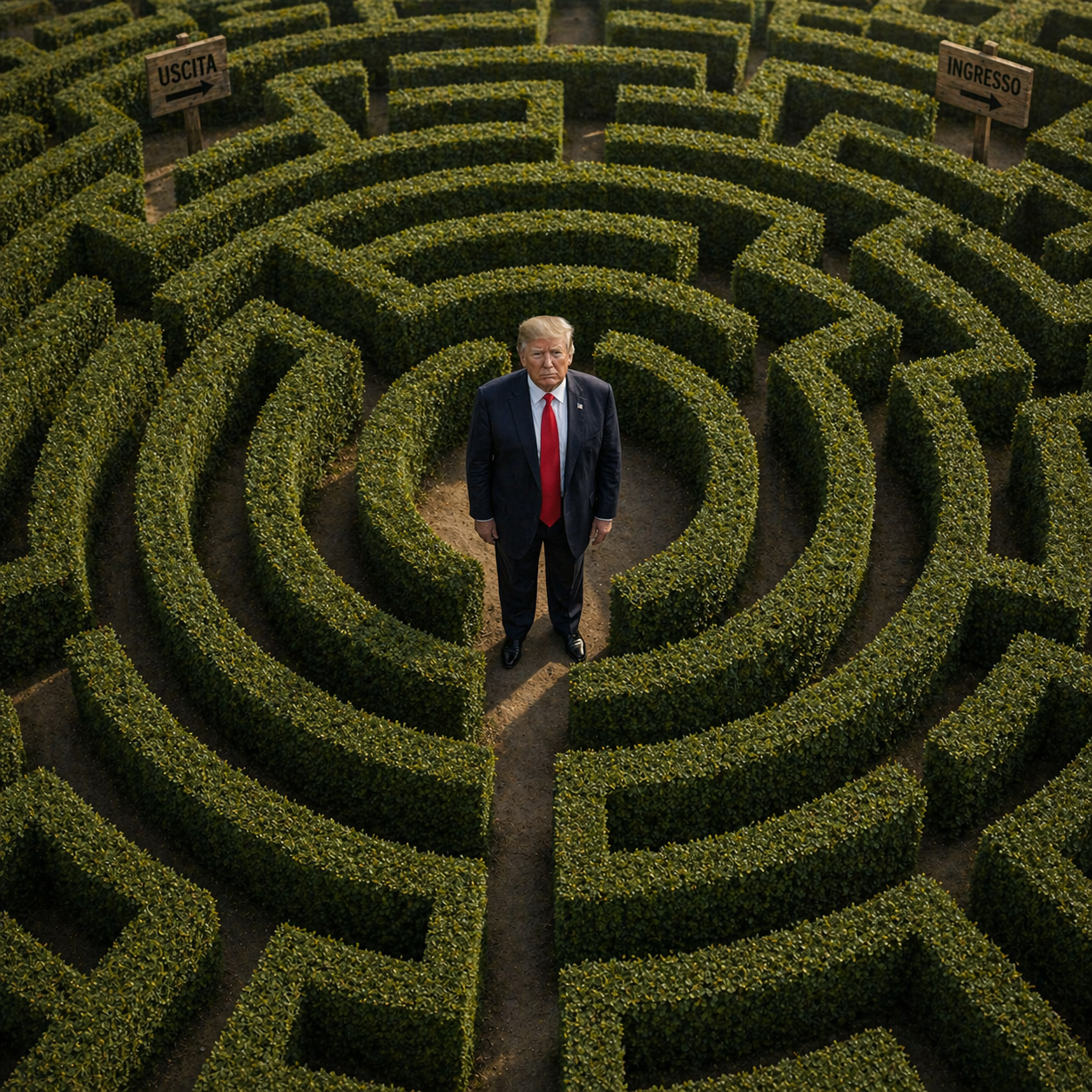
And so, whatever the outcome of the Iranian carnage, Trump appears ever more as a general lost in his own labyrinth — deluded into believing he can still dictate the terms of history, yet in reality encircled, overwhelmed by scandals, and compelled to lend further support to an actor who either provokes a new ware ach day or risks imprisonment, now even for established crimes against humanity. As for us Europeans, owing to a political leadership class shaped in the era of social networks and incapable of envisaging a horizon beyond uncritical vassalage towards America and Israel, we have remained spectators —that is to say, accomplices — in a world war no longer in fragments that, even should it end, will have devastated our economies, our certainties, and our prospects for the future.
Roberto Bertoni