Roberto Bertoni
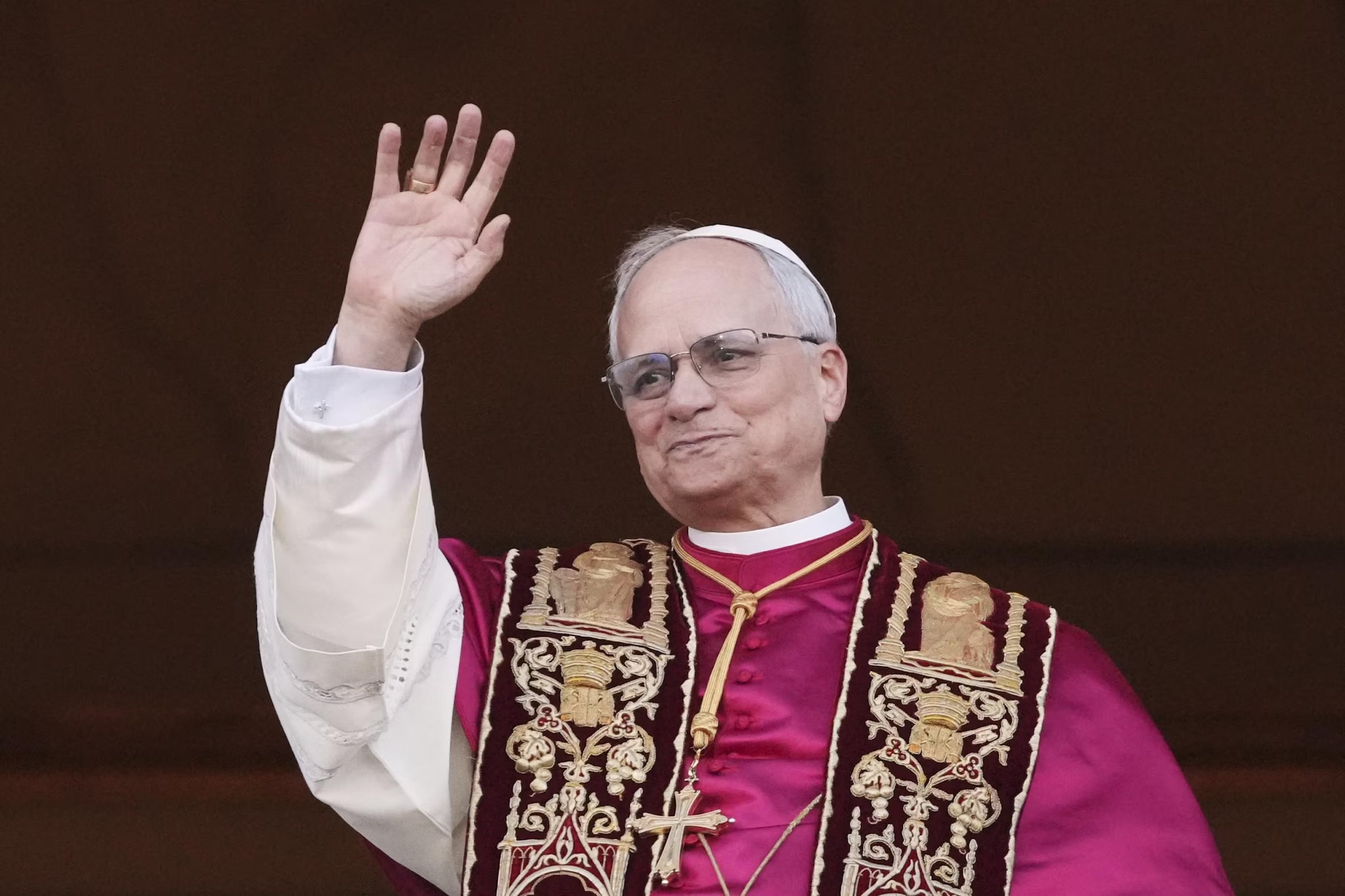
What escapes Donald Trump is that with someone like Leo XIV, turning up the volume — to the point of making statements that would warrant a psychiatric hold — achieves very little. This mild-mannered Augustinian, unlike Francis, is not the trench-warfare type, does not go in for grand gestures, and does not possess, perhaps, the same prophetic charge as his predecessor; nor does he give interviews to talk shows, at least not yet. The thing is, on the rare occasions when he does speak, he does so with precision and clarity, drawing unanimous approval from every corner of the world. And so, if Francis was a pope we loved almost to distraction — if only for his courage, his determination, and his embodiment of the universal message of the Gospel — Leo is the moderate version, though no less effective for that.
The differences between the two are considerable: one was a Jesuit, the other is an Augustinian; one appeared without the sacred vestments, starting with the mozzetta, while the other, upon his election to the pontifical throne, had no qualms about putting them on; one lived in the austere residence of Santa Marta, while the other has restored the papal apartment to use; and even at the level of expression and doctrine, there are some discrepancies visible to the naked eye. That said, they share the same pacifism, the same sense of justice, the same concern for the least among us, the same rejection of violence and brutality and — let us be frank about it — the same aversion toward someone like Trump, whose eruption onto the global scene is generating an unprecedented process of destabilisation.
Trump’s latest accusation, launched on the very eve of Secretary of State Rubio’s visit to Italy — namely, the alleged complaisance of Leo XIV toward an Iranian nuclear weapon — speaks volumes about the total absence of diplomacy in the man and his failure to grasp how international relations actually work. What escapes him is not only the prestige of the Pontiff, but also the Holy See’s skill in untangling the world’s knots: one need only think of the role played by Vatican Secretary of State Pietro Parolin, and of the open hostility of the American episcopate toward a President increasingly perceived as a disruptive element. As for Iran, no one thinks that one should be indulgent toward a regime that continues to hang hundreds of people — many of them young, very young — whose only crime was to have rebelled, and to go on rebelling, against a theocracy now teetering on the brink of collapse, carrying with it its full cargo of obscurantism, inhumanity, and brutality. Equally, no one — least of all Pope Leo — would ever dare support the ayatollahs, or suggest that the world would be better off if they had the bomb. The point is that Trump’s threats of the potential destruction of Israel, Europe, and whatever other state or continent happens to come to mind betray his warmongering obsession, his mental confusion, his desire to enrich himself with Iranian oil, his business instincts pushed to the extreme, and his propensity for lying — which has, alas, become proverbial, but is nonetheless capable of upending global markets and sending the price of oil shooting to uncontrollable levels.
Leo, we repeat, is a mild man — apparently quiet, but utterly firm. His condemnation of liberal globalisation is unequivocal, and his intimate knowledge of American reality allows him to analyse its distortions with the same competence as Francis, if not with an even more critical eye, taking up Bergoglio’s denunciations of an economic model that discards, excludes, and often kills the weakest; that leaves behind those born into poverty; and that destroys the heritage of the Earth to the point of threatening the very survival of the planet. Prevost’s concept of synodality also mirrors Francis’s"Todos, todos, todos!": a Church open to all; the God of Advent; the journey alongside the excluded; closeness to the oppressed; an outstretched hand toward those who have gone astray; forgiveness; and the rejection of every form of conflict.
If someone at the White House was hoping for a kind of anti-Christ — a MAGA preacher ready to bless the cannons, a Pope compliant toward a string of figures who are blasphemous by their very nature, or a member of that evangelical galaxy that flourishes above all in the Southern states but is about as far from the Christian and Catholic message as one can imagine — we are sorry to disappoint them, but they got the opposite. Pope Leo does not take sides with this or that government: he interprets the word of God and carries it forward with rare determination and extraordinary courage. A year on, we can, in short, say that he has won us over. Of course, we miss the Bergoglian style — his accessibility, his extreme humility, his extraordinary kindness, and everything we adored over the twelve years of his pontificate — yet we do not feel orphaned. Nor does it make sense to draw comparisons: Prevost’s historical legacy will be assessed at the end. For the rest, each person is themselves and deserves respect as a human being. The continuity between the two seems sufficient for us to be satisfied; the distance from Trump reassures and heartens us; and the attentiveness to the world’s suffering does not surprise us — though we could not have taken it for granted — and yet there it is before our eyes at every moment: twelve months of Leo XIV have transmitted to us the same sensation of authenticity we felt listening to Francis, and the idea of a “disarmed and disarming peace” is, at present, the cornerstone of his thought.
After all, we venture to suspect that a Jesuit like Bergoglio — well aware that he did not have long to live — prepared the succession with care, creating certain cardinals and not others, and opening the Church to the world, so as to make it a truly universal bearer of a message. Leo XIV, in short, walks the path traced by Francis, interpreting each passage according to his own personality. “Todos, todos, todos!”: an exhortation more timely than ever, at a moment when democracy is living through one of its darkest seasons and is being called into question even in places where we never imagined it would be; at a moment when we cling to spiritual values capable of restoring to us a sense of inner fullness, since the carnality of politics seems to have vanished almost everywhere.
One year on, and our prayer — as laypeople — goes to that man who came “from the ends of the earth” and who today lies buried in the bare earth at Santa Maria Maggiore; because if we have a successor who reminds us of his inner beauty, it is also — if not above all — thanks to him.