Alessandro Giacone
Tajikistan is often referred to as the “other roof of the world” (after Nepal), because 90% of its territory is covered by mountains. Its highest peak is Ismail Samani Peak (7,495 m), formerly known as Communism Peak. Unlike its neighbors, the country is rich in water resources thanks to the presence of around one thousand rivers. The Rogun Hydropower Plant, currently under construction in the Pamir region, will, at 335 meters, become the tallest dam in the world. Italian companies are involved in the project. The initiative is strongly opposed by Uzbekistan, which fears a reduction in water flows reaching its territory.
Tajikistan also stands out from its neighboring countries because its population speaks a Persian language. Most of the population is concentrated in the capital, Dushanbe, and in the Fergana Valley, where the country’s two other major cities, Khujand and Panjakent, are located. The dominant religion is Sunni Islam, although there is also an Ismaili minority, whose highest authority was Prince Aga Khan. Commander Ahmad Shah Massoud (1953–2001), the “Lion of Panjshir,” was also a Tajik.
Like the other Central Asian republics, Tajikistan became independent in 1991. However, the legacy of seventy years of Soviet rule has not entirely disappeared. Lenin statues were not demolished but moved to less prominent locations. In the main squares, they have been replaced by national figures such as Ismail Samani, founder of the Samanid dynasty (which ruled from 819 to 999 CE), and the great poet Rudaki. Unlike Uzbekistan, which began a transition to the Latin alphabet in 1995, Tajikistan continues to use the Cyrillic alphabet.
More than by Soviet occupation, the country remains marked by the wounds of the civil war of 1992–1997. Following independence, extremist movements emerged with the aim of establishing an Islamic republic modeled on Iran. The conflict claimed approximately 100,000 lives and forced a very large number of Tajiks to flee abroad. Nearly one million Tajiks now live in Russia, and remittances from migrant workers account for roughly half of the country’s national income. More recently, Russia reopened a military base in the south of the country.
This history has resulted in a complex relationship with religion. After the state atheism of the Soviet period, Islam has once again become widely practiced, particularly among older generations, who attend Friday prayers in large numbers. However, access to mosques is restricted for children and teenagers in an effort to prevent the Islamization of the country. Girls generally do not wear the veil. Throughout the country, one can see groups of schoolchildren walking to school in shirts and ties; the education system places strong emphasis on languages and scientific subjects.
From an economic perspective, Tajikistan is significantly less developed than neighboring Uzbekistan. The minimum wage is below €100 per month, while the average salary is around €250, with substantial disparities between urban centers and rural areas. Economic growth nevertheless exceeds 8%, and the major cities are experiencing a construction boom, although the aesthetic quality of many new buildings is not always outstanding—perhaps another legacy of the Soviet era. Tajikistan is gradually opening itself to major trade flows and maintains economic relations with 180 countries. Chinese influence has expanded considerably. Chinese investments are particularly visible in infrastructure projects: in mountainous regions, the old high-altitude Soviet roads have been replaced by Chinese-built highways running at lower elevations thanks to countless tunnels. As a result, Tajikistan has become an important link in the New Silk Road, albeit at the cost of growing dependence on its powerful Chinese neighbor.
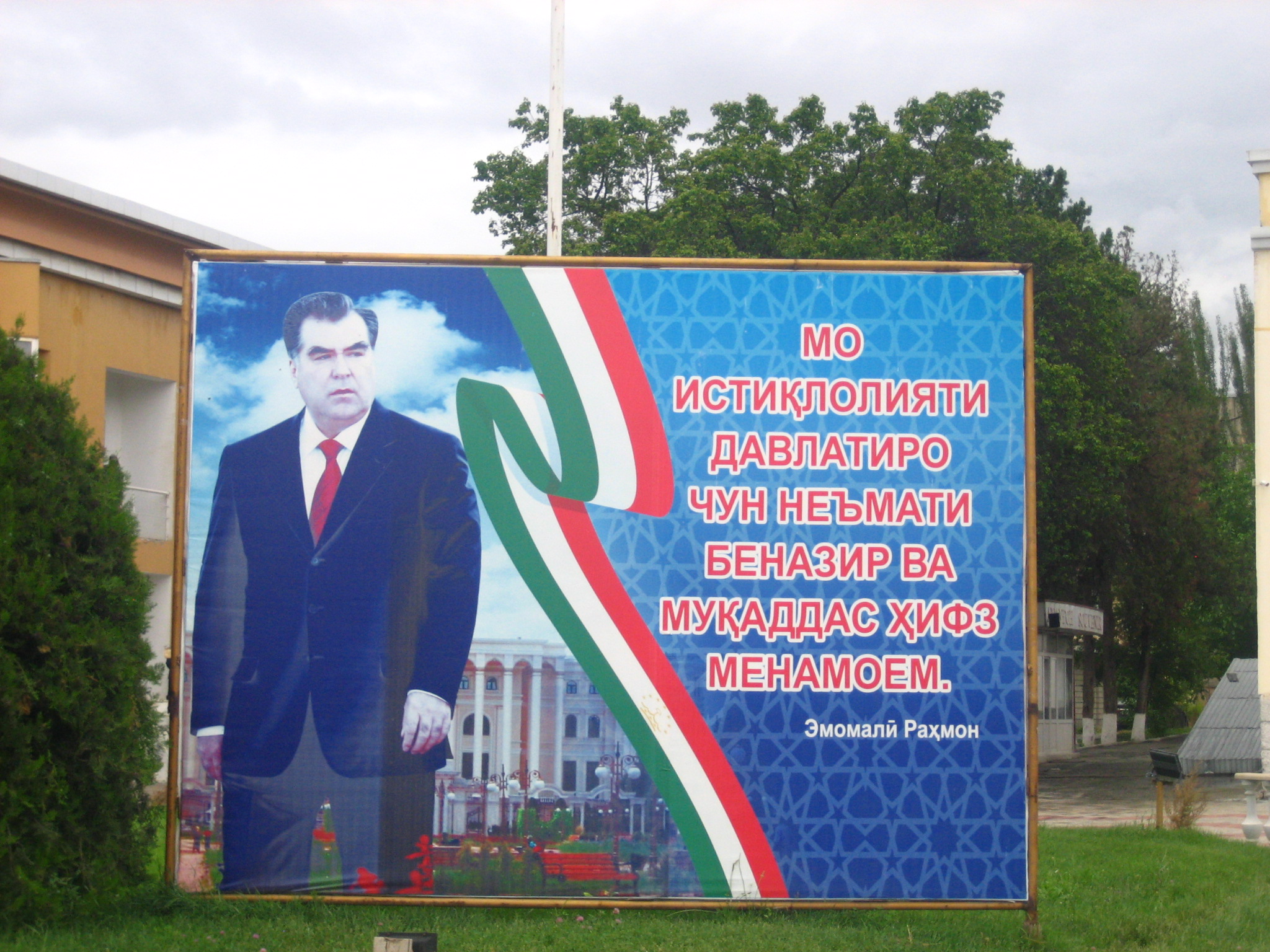
Politically, Tajikistan is an autocracy. President Emomali Rahmon, who bears the title “Father of the Nation,” has been in power since 1992 and has been continuously re-elected since 1994. He is widely credited with ending the civil war. His portraits are ubiquitous—and often overwhelming—throughout the country. His son, Rustam Emomali, serves as mayor of Dushanbe, and it requires little foresight to predict that he will eventually succeed his father. In essence, Tajikistan exhibits a form of authoritarian presidentialism broadly similar to that practiced by Islam Karimov, who ruled Uzbekistan from 1991 to 2016. Following Karimov’s death, Uzbekistan experienced a degree of political liberalization. It remains to be seen what will happen when Rahmon’s decades-long rule finally comes to an end. Until then, Tajikistan is likely to remain politically stagnant.