Giorgio Malfatti di Montetretto
The Entry of Azerbaijan into Central Asia In this context, a significant development has recently taken place with the inclusion of Azerbaijan in the consultative group of Central Asian countries, transforming the C5 into the C6. The group has so far focused on issues such as trade, foreign policy, and dispute resolution. The new configuration, now involving both shores of the Caspian Sea, also represents a response to the repercussions of the war in Ukraine and Western sanctions against Russia, which have made it necessary to seek alternative logistical solutions. Thanks to ethnic-religious affinities and a shared Soviet legacy, Azerbaijan integrates smoothly into the Central Asian environment, where Tajikistan represents the only exception due to its Persian origins. The country actively participates in European neighbourhood and Eastern Partnership programmes and plays an essential role in energy corridors toward Europe. Baku also maintains privileged relations with Turkey and adopts a balancing position between Russia, the United States, the European Union, and China. The resolution of the Nagorno-Karabakh conflict and the agreement on the Zangezur Corridor—strongly supported by Donald Trump—which will connect Azerbaijan to Turkey via Armenia, have further strengthened the country’s international prestige, consolidating its role as a key regional actor.
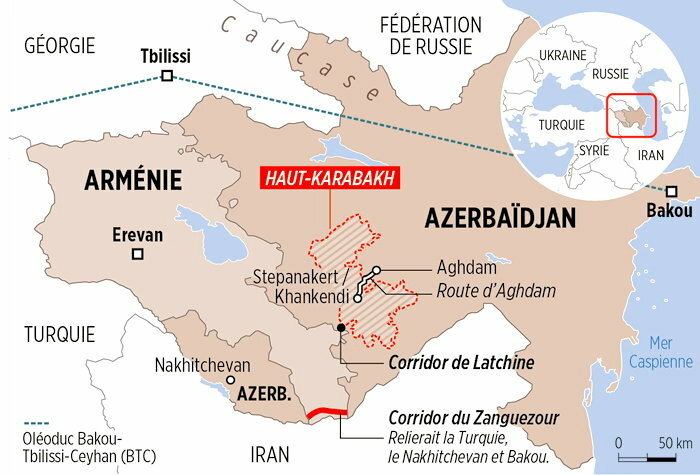
The Zangezur Corridor The construction of a road and railway link of approximately 43 km constitutes one of the main innovations in the infrastructural and geopolitical landscape of the South Caucasus. Formally, the project aims to connect Azerbaijan with its exclave of Nakhchivan; in perspective, however, it would create a continuous land corridor between the Caspian Sea and Turkey, with direct implications for access to European markets. In this framework, the initiative is also perceived as functional to the diversification of Eurasian energy routes toward the West, reducing the centrality of transit corridors controlled by Moscow and, consequently, Russia’s ability to exert pressure on countries dependent on its supplies. The proposed route would run along the border zone between Armenia and Iran. According to reports, Aliyev and Pashinyan discussed during their meeting at the White House (August 2025) the possibility of entrusting the management of the route to the United States under a lease contract of up to 99 years; hence the designation TRIPP (Trump Route for International Peace and Prosperity). Tehran, however, considers the corridor a direct threat to its national security. Beyond US involvement, it could affect the short but strategically important land border between Iran and Armenia, compromising a transit route significant for Iran toward Russia and the Black Sea. For Moscow, the Zangezur issue more broadly represents an indicator of the erosion of its influence in the South Caucasus. The Armenian–Iranian border follows the course of the Aras River and is jointly patrolled by Armenian and Russian border guards, under existing military cooperation agreements between the two countries. The corridor, in its proposed form, would pass immediately north of this line. In an effort to avoid the project being interpreted as an explicit acknowledgment of its marginalisation, Russia has repeatedly emphasised the still preliminary nature of the initiative. Foreign Minister Sergey Lavrov stated that “in reality not everything has been agreed,” a view that does not appear fully consistent with the state of the understandings that have emerged. Ultimately, the dynamic highlights the growing difficulty of the Kremlin in imposing conditions on Baku, which is now in a position of strength, while Yerevan—also in light of the deterioration of trust toward Moscow after the outcome of the Nagorno-Karabakh issue—tends to favour alternative interlocutors.
The Alternative Route through Afghanistan Within this dynamic, additional ideas and projects have emerged for the development of new trade and energy routes, including corridors toward India or Pakistan through Afghanistan. In this diversification strategy, Afghanistan has also come to play a role, as perceptions among Central Asian states have changed since 2022. From being a traditional factor of regional instability, the country has gradually come to be seen as a functional interlocutor in the energy, trade, and infrastructure sectors. Relations with the Taliban government are based on a pragmatic approach. Post-Soviet states were among the first to establish diplomatic contacts with the Taliban, who remained isolated after taking power in 2021. The normalization process accelerated following the Russian invasion of Ukraine. Uzbekistan and Afghanistan have never closed their embassies, while other countries have established relations through chargé d’affaires, without formally recognising the Taliban government. The Afghan issue was recently addressed within the C5 format in Tashkent (without the participation of Turkmenistan), where a common policy toward Kabul was agreed upon, focused on safeguarding vital regional interests. This has fostered pragmatic cooperation, leading to the provision of energy and basic goods to the Taliban. This is not charity, but prevention against crises and instability in the north. Central Asian states prioritise cooperation with the Taliban government, avoiding issues that could undermine ongoing dialogue. In Central Asia, human rights and governance issues remain secondary compared to threats from Islamic fundamentalism, particularly from groups affiliated with the Islamic State of Khorasan (ISIS-K), which require constant cooperation with the authorities in Kabul. Turkmenistan, although more discreet, has developed strong ties with the Taliban, mainly for the construction of the TAPI gas pipeline (Turkmenistan–Afghanistan–Pakistan–India). Tajikistan, on the other hand, while maintaining limited relations with the Taliban (influenced by historical tensions linked to the figure of General Massoud, leader of the Afghan resistance of Tajik origin), considers cooperation useful to mitigate the risk of terrorist attacks and the recruitment of its citizens into Islamist militant groups. Prospects for trans-Afghan trade corridors are seen as opportunities to access South Asian markets and thus reduce dependence on China and Russia. However, these plans remain constrained by instability in relations between Kabul and Islamabad. Tensions over the Durand Line, Pakistani accusations of support for Tehrik-i-Taliban Pakistan (TTP), and recent armed clashes—later evolving into a fragile ceasefire—have reduced security guarantees for strategic infrastructure, putting at risk the viability of key projects such as TAPI and the trans-Afghan railway. (4 – to be continued)