Giorgio Malfatti di Montetretto
The Caspian represents the only major maritime basin in Central Asia. A body of salt water, with no outlet to the open sea, in which the interests of the coastal countries have shaped negotiations over its legal regime.
The question of the Caspian Sea gained importance following the dissolution of the USSR, an event that increased the number of littoral states from two (Iran and the Soviet Union) to five (Iran, Azerbaijan, Russia, Kazakhstan, and Turkmenistan), and subsequently led to the discovery of major new hydrocarbon deposits. The region stretching from the Caucasus to Central Asia is one of the oldest oil-producing areas in the world, and had remained largely unexplored until the collapse of the Soviet Union, which had prioritized exploration in Siberia. From that moment on, Kazakhstan, Azerbaijan, Turkmenistan, and Uzbekistan were seen by multinational oil companies as alternative suppliers to Russia and therefore as territories worthy of significant investment.
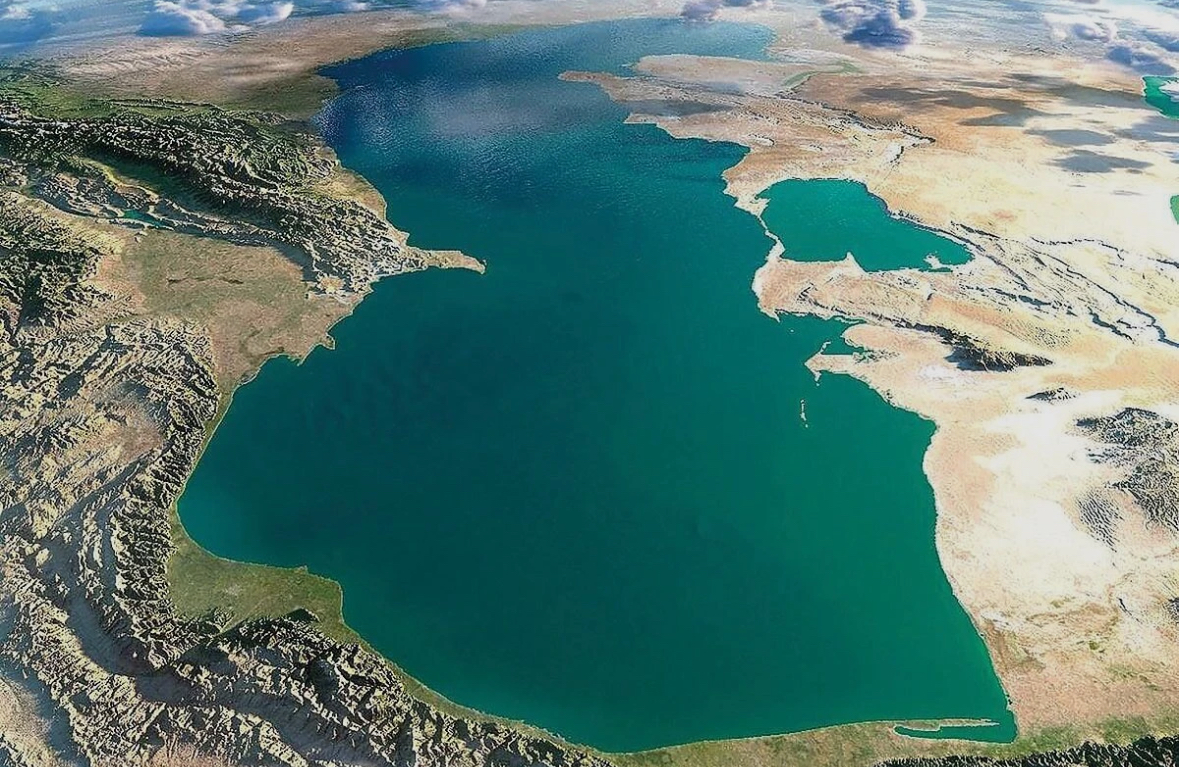
Geographically, the Caspian Sea is the largest inland body of water on the planet and has no natural connection to other seas. Its surface lies within a vast depression, 28 meters below sea level. It has roughly 6,000 kilometers of coastline and a maximum depth of just over 1,000 meters. Its uniqueness lies in its biological diversity of flora and fauna, including numerous plant and animal species, among them 90% of the world’s sturgeon population. It is a particularly fragile ecosystem due to its varied climatic conditions. The border between Europe and Asia runs through the Caspian: the northern shore, between the mouth of the Ural River and the so-called Kuma–Manych Depression, is European, while the eastern, southern, and western shores are Asian.
Being entirely landlocked, the Caspian was not included in the 1982 United Nations Convention on the Law of the Sea (Montego Bay) and is therefore considered a lake. Until 1991, the USSR and Iran had never been interested in resolving the issue of maritime boundaries in the Caspian Sea. The only dispute concerned not oil, but sturgeon fishing—the other major resource, whose roe is the key ingredient of the famous beluga caviar, which allowed Moscow to maintain a monopoly on the global caviar trade. The Iranians, also exporters of caviar, for the first time took a firm stance and prevented fishing off their coasts. The USSR was thus forced to accept an agreement restoring a balance of mutual rights. In practice, throughout this period, the Caspian was advantageously regarded by both sides as a Soviet-Iranian sea.
In 1991, after the dissolution of the Soviet Union, the question of the legal regime of the Caspian Sea became a geopolitical issue. Despite its relatively small size, it is extremely rich in underwater natural resources, especially hydrocarbons. The seabed is dotted with offshore oil and gas fields, which coastal states seek to control in order to fuel their economic development. Five states now border the Caspian—Russia, Kazakhstan, Turkmenistan, Azerbaijan, and Iran—and multiple civilizations overlap there in a relatively peaceful way, though latent tensions persist.
The three new independent states (Azerbaijan, Kazakhstan, and Turkmenistan), having discovered significant deposits thanks to international oil companies and seeking alternative routes to Russia for their pipelines, challenged the legal validity of previous treaties, which had remained uncontested for decades by both the international community and the signatory states. The abandonment of the existing—albeit ambiguous—legal regime of the Caspian Sea was linked to the issue of legal succession of the new post-Soviet entities.
The 1978 Vienna Convention on Succession of States in respect of Treaties provides that, in the event of state separation, any treaty in force at the time of succession remains valid unless the parties decide otherwise. Thus, in the case of the Caspian Sea, the rights and obligations of the predecessor state (the Soviet Union) and its successors deriving from international legal instruments remain equally binding. This was also affirmed in the 1991 Alma-Ata Declaration, in which all new states, by joining the Commonwealth of Independent States (CIS), committed themselves to fulfilling the obligations arising from treaties and agreements concluded by the former Soviet Union.
The fact that the Caspian has no outlet to the open sea (and therefore does not correspond to the traditional definition of a sea under the Montego Bay Convention) raised doubts about the true nature of this body of water: is it a sea or a lake?
From this point onward, two opposing blocs emerged defending antagonistic interpretations.
Russia and Iran, referring to the first part of the definition of a “semi-enclosed sea” in Article 122 of the UN Convention on the Law of the Sea (“a gulf, basin or sea surrounded by two or more States and connected to another sea or the ocean by a narrow outlet”), argue that since the Caspian is not connected to any other sea basin, it should rather be considered a lake, or at least a space requiring joint management of all economic activities and equitable sharing of revenues among coastal states. In practice, a condominium regime. They support this view with pre-1991 treaties and customary practices related to transboundary lakes, given the absence of a specific convention on lake law.
Azerbaijan, Kazakhstan, and at times Turkmenistan, argue instead that, under the second part of the same article, the Caspian should be defined as a sea and therefore subject to the full application of the Montego Bay Convention. This would imply the use of the median line principle, according to which borders are drawn along points equidistant from the shores.
In reality, the legal status of the Caspian escapes codification under international maritime law, fitting neither fully into the category of sea nor lake. In the latter case, customary international law would apply, leaving room for interstate agreement. The classification as a sea would entail the application of exclusive economic zones (EEZs), extending up to 200 nautical miles, but the Caspian is not large enough for such zones not to overlap, leading to competing claims.
The 2018 Aktau Convention
In 2018, after more than twenty years of diplomatic negotiations, the coastal states signed a convention on the legal status of the Caspian. On 12 August 2018, Russia, Iran, Kazakhstan, Turkmenistan, and Azerbaijan signed in the Kazakh port city of Aktau the Convention on the Legal Status of the Caspian Sea, defining it as an intercontinental body of water with a special status. The agreement represents a compromise that overcomes the sea/lake dichotomy.
However, it does not settle all disputes, particularly regarding the division of the seabed, which remains crucial for energy exploration. It establishes territorial waters extending 15 nautical miles (22 km) from the coast and fishing zones, while the remaining waters are considered common maritime space. Yet it does not definitively resolve pipeline disputes or environmental veto mechanisms, leaving room for future contention.
The new status allows the application of international maritime law in part, and each capital has effectively sought to claim an EEZ, but overlaps are inevitable. Russia and Kazakhstan dispute central northern zones rich in gas, while Azerbaijan, Turkmenistan, and Iran compete in the south, richer in oil.
The 2003 Tehran environmental convention and subsequent Russian-Iranian cooperation have repeatedly been invoked to block trans-Caspian pipeline projects, particularly those linking Azerbaijan, Kazakhstan, and Turkmenistan. Environmental arguments may continue to be used as geopolitical tools.
The Caspian has also become increasingly integrated into wider Eurasian transport and energy networks, particularly the International North-South Transport Corridor (INSTC), linking Russia, the Caucasus, Central Asia, Iran, and the Indian Ocean, with key ports such as Makhachkala and Amirabad gaining strategic importance. (5 - to be continued)