Giorgio Malfatti
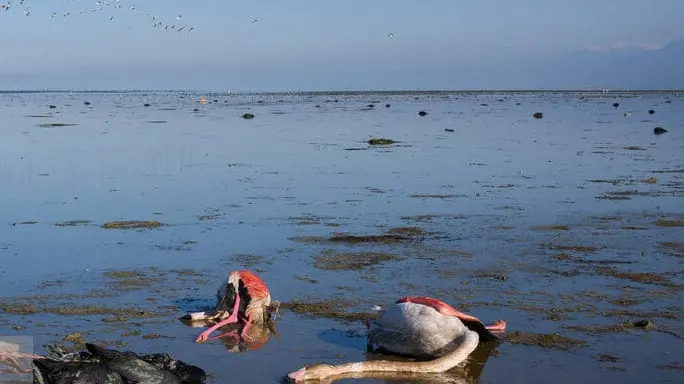
The broader context described above sometimes makes us forget that the Caspian Sea is by no means in good health. Several studies have shown that its water level could drop rapidly due to global warming: a decline of between nine and eighteen meters is expected by the end of this century. Temperatures are rising, water is evaporating, and precipitation is decreasing. A perfect mix for an uncertain future.
The main tributaries of the Caspian are the Volga and Ural rivers, whose flow has decreased for the reasons already mentioned. The rest is due to increasing withdrawals by the coastal states (also to address drinking water shortages in some areas) and the numerous dams built by the Russians on the Ural and the Volga. This would result in a loss of about a quarter of its surface area, with the consequent emergence of approximately 93,000 km² of land, equivalent to the size of Portugal.
The shallow waters in the southern part teem with mollusks, crustaceans, and fish; in winter, freshwater seals (a very rare species) raise their pups on the ice that forms only in this area of the lake. Moreover, the extensive river system and vast wetland areas attract many species of migratory birds and provide an ideal habitat for a unique flora and fauna.
The threat to this ecosystem lies not only in desiccation, but also in untreated wastewater, uncontrolled fishing, and waste from gas and oil production—these latter being major sources of employment and wealth for coastal populations.
Climate change has also made water management, fisheries, and the salt industry particularly complex. The clearest example is the large Garabogazköl Bay in Turkmenistan, characterized by seasonal fluctuations in water levels (there are no tides), which create serious water management problems. There is concern that the bay may dry up, as happened with the Aral Sea, with which the Caspian shares geological origins.
To prevent this problem, in 1980 Soviet authorities decided to separate the Caspian Sea from its appendix by means of an artificial dam. The aim was to prevent the continuous drying of waters flowing in from the Caspian, thereby lowering the level of the Caspian itself. However, salt accumulation in the bay—carried inland by winds—caused significant environmental damage, leading to vegetation loss and a reduction in wildlife. The authorities of independent Turkmenistan therefore had to reopen the dam, allowing the bay to refill with water.
In the past, the Caspian Sea was one of the least militarized bodies of water in the world. Over the past decade, however, this characteristic has gradually disappeared due to regional tensions and, above all, the deterioration of the international security environment, further worsened by conflicts in Ukraine and the Middle East.
Russia is the dominant military actor in the basin, having inherited most of the Soviet Caspian flotilla. Since the beginning of the war in Ukraine, Moscow has strengthened its naval presence in the area, transferring units from the Black Sea via the Volga-Don Canal. The Caspian has thus gained increasing operational importance, being used as a launch platform for cruise missiles and bombers targeting Ukrainian objectives.
In response, Ukrainian forces have struck the main Russian naval base in Dagestan, damaging the flagship of the flotilla and other vessels. At the same time, the Caspian basin has taken on a growing strategic role in strengthening military cooperation between Russia and Iran. Its waters have been used as a logistical corridor for the transfer of weapons, including drones and missiles.
Israeli military operations also fit into this context, striking Iranian naval targets in the Caspian Sea and disabling several units and infrastructures in an unprecedented action for this theater. The Caspian is not the core of Tehran’s navy, but for Russians and Iranians it is a junction and supply point. A monitoring center tracking hostile activities against Israel had recorded an increase in clandestine shipments of missiles and drones from Iran to Russia, at least four of which reportedly passed through Caspian waters.
The increased militarization has also led other littoral states to strengthen their naval capabilities. Kazakhstan, Turkmenistan, and Azerbaijan have launched programs to modernize their respective fleets. Iran, for its part, while having a structurally limited Caspian navy, has increased its presence in the basin, confirming its strategic importance within its regional projection.
This dynamic has also had consequences for civilian security. The intense military activity has made the Caspian an increasingly dangerous space for air and maritime navigation, as illustrated by the accidental downing, in Russian airspace, of an Azerbaijan Airlines civilian flight bound for Grozny, which crashed near the Caspian city of Aktau.
In the absence of significant progress on the delimitation of the seabed and the establishment of shared security management mechanisms, the Caspian Sea today appears as an area with a high potential for instability, where geopolitical rivalries, strategic interests, and growing risks for all regional actors are intertwined. (VI - to be continued)