Grégory Herpe
On the night of May 23-24, 2026, I watched the sky over Kyiv.
The sirens had sounded shortly after midnight. I was in my hotel room working on the photos I had taken during the day, and I stepped out onto the terrace – the instinct not to miss what the walls of an apartment would have hidden. The sky seemed pierced by the luminous trails of falling missiles, glowing like flashes of fire. Then the dull detonations in the distance, the closer explosions whose blast you felt in your ribcage before you even truly heard them. As if waves of pressure were passing right through us. The anti-aircraft batteries chattering in bursts. Then the drones – small, fast points, humming discreetly, before the total conflagration of the sky, of the city.
That night, Russia launched 90 missiles and 600 drones at Ukraine.
The Ukrainian Air Force intercepted 55 and 549 of them, respectively. The figures are clean and neat. The reality that remains after the figures is not.
Among the missiles, one was an Oreshnik.
The weapon no one wanted to see
The Oreshnik is an intermediate-range hypersonic ballistic missile. It travels at a speed that current defense systems struggle to process. Its particularity – and its implicit message with every use – is that it can carry nuclear warheads.
It wasn’t carrying one that night, but the message was clear. Russia had already used the Oreshnik twice since the beginning of the invasion: in November 2024 against a military factory, in January 2026 against an aerospace site in western Ukraine, just kilometers from NATO borders. In both cases, no confirmed nuclear payload.
The weapon exists, it flies, and Moscow chooses when to show it.
That evening, Zelensky confirmed its use on Telegram, Ukrainians’ favorite social network. The Russian Ministry of Defense did too, on the same network, with a polished statement: the strikes were in response to “Ukraine’s terrorist attacks on Russian civilian infrastructure” and had only targeted “military objectives.”
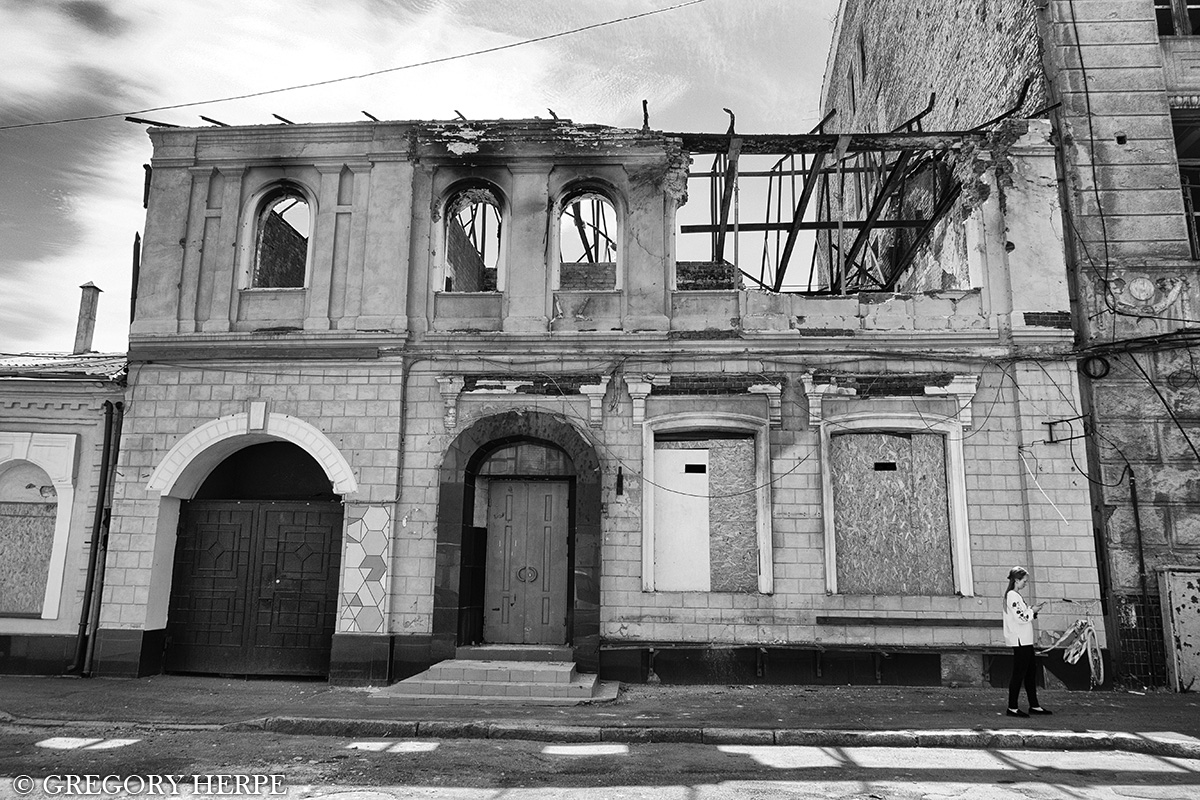
The next morning, walking through the Podil district, I noted that the Russian strikes had very largely hit civilian apartment buildings.
The Chernobyl Museum was burning
In the lively and popular Podil district, the National Museum of Chernobyl lay, gutted, smoking, a stone’s throw from the Dnieper River. Reopened in April 2026 after eighteen months of restoration, to mark the fortieth anniversary of the April 26, 1986 catastrophe, little of it remained. Everything a generation had built so that the most serious reactor accident in history would not disappear into abstraction had therefore caught fire one month after its reopening.
According to the Ukrainian Ministry of Internal Affairs, 40% of the exhibited items were destroyed or damaged. Archives, photographs, objects recovered from the exclusion zone. I speak with the rescue workers who have been on the job for hours, and the museum employees sitting on a sofa salvaged from the building and placed on the sidewalk. They are dazed, eyes reddened from smoke and tears. One of them tells me she has lost her job since nothing is left, but she keeps smiling and has faith in her army.
In the same night: the National Philharmonic, the Kyiv Small Opera, the Yaroslav the Wise National Library, the Shevchenko Institute of Literature, the Ukrainian House Cultural Center, the National Art Museum were hit. Four dead, about a hundred wounded, two dead in Kyiv itself.
Russia had targeted military objectives. No Ukrainian believes that; nor do the observers.
I photographed the gutted facades, the windows blown out into the street, the firefighters rushing from one building to what was once a trendy restaurant. The kind of scene you know, as you watch it, will be forgotten in four to eight hours by the news channels – replaced by the next one, and then the next.
That, perhaps, is the real war of attrition. Not the bodies, but the progressive indifference of distant witnesses.
Brovary – children between two alerts
Brovary is a satellite city of Kyiv, about twenty kilometers to the northeast. It was among the first localities targeted during the invasion of February 2022 – the Russian armored columns coming up from Belarus passed through or bypassed it in their attempt to take the capital. The tanks retreated. The city remained.
I was there working on my project with Ukrainian children. Teaching them photography in a fun way, without tedious technique, then organizing exhibitions of their photos and mine. An art therapy program of sorts, which I had already tested in Moldova, Cambodia, and elsewhere. A program that highlights them and gives them the rightful feeling of mattering.
What isn’t said enough about the children who have been growing up here for four years is that they have developed a relationship with danger that has nothing to do with ours anymore. They know how to distinguish the sound of a drone from that of an airplane. They know, when the alert sounds during one of the photo workshops I’ve set up, how many seconds it takes to reach the shelter – without running, but without dawdling. They do this with a calm efficiency that twists your stomach.
An eleven-year-old boy explained to me, very seriously, that he preferred nights with drones because “at least you can see them coming.” Missiles are more complicated. They arrive too fast.
Eleven years old, and a maturity, a composure, that commands respect.
From the very first alert, when the siren went off and we went to take shelter in the bunker of the association that takes care of them, I understood that I was dealing with extraordinary children. They kept singing, playing, as if to trick the danger and stay in the world of children – as far away as possible from the reality of adults, so pitiful.
Kharkiv – below ground level
In Kharkiv, I visited several of the underground schools.
Ukraine’s second-largest city is forty kilometers from the Russian border. Building schools on the surface here means building targets. I saw the former kindergarten of the Honey Academy, destroyed by three drones at the end of 2025; nothing remains but ruins, a few children’s toys, a SpongeBob plushie, a little Maya the Bee ball… Fortunately, the children had taken refuge in the basements in time.
So the city started digging – literally. Seven underground facilities are now operational, with the goal of opening forty-three to accommodate 80,000 children by the end of the year.
For the most part, these are real schools. Not makeshift shelters. Classrooms with appropriate furniture, screens, books, science rooms where I saw students building 3D printers out of plywood, cables, and salvaged materials. The youngest in the morning, up to fifth grade, the older ones in the afternoon. From 9 a.m. to 3:30 p.m. There is a cafeteria, on-site psychological support – regular screening reveals that three out of every hundred children show concerning disorders; how could it be otherwise.
Three out of a hundred. In a city that has been bombed daily for over four years.
The teachers I met did not look broken. They do their job with the constraints they are given – the same focused expression, the same attention to pedagogical detail as a teacher in Paris or Rome. Normality as an act of resistance.
A reinforced concrete ceiling above the notebooks. The children do their homework. Life continues 10 or 15 meters below ground level. (1 – to be continued)