Chloé Maurel
An emblematic monument showing the tensions between heritage preservation and tourist exploitation
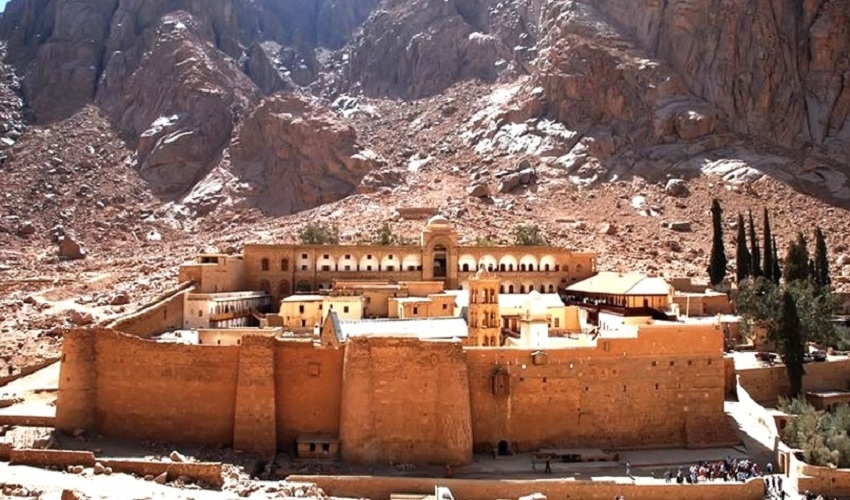
Situated at an altitude of 1,570 metres in the southern part of the Sinai Peninsula, at the foot of Mount Horeb, identified by biblical tradition as Moses’ Mount Sinai, Saint Catherine’s Monastery, also known as the Monastery of the Transfiguration, is an Orthodox Christian place of worship and one of the oldest continuously inhabited Christian monastic institutions in the world. Founded during the reign of the Byzantine Emperor Justinian I between 548 and 565, this fortified complex represents an exceptional religious, historical, artistic, and geopolitical heritage. Yet today it is under serious threat. What conflicts are crystallising around it, symbolising the recurring tensions between religious, heritage, economic, and geopolitical concerns?
Since its inscription on UNESCO’s World Heritage List in 2002, the monastery has been regarded as a universal symbol of dialogue between civilisations and of coexistence among Judaism, Christianity, and Islam. In recent years, however, the site has become the centre of a major crisis opposing two contradictory logics: the preservation of a millennia-old sacred place on the one hand, and its economic and tourist exploitation by the Egyptian state on the other. Recent real-estate developments, legal disputes concerning ownership of the monastery, and the recent closure of the site reveal the growing fragility of a monument whose historical balance is now seriously threatened.
A Milennial History
The history of the monastery is rooted in the long tradition of Eastern monasticism that emerged in the deserts of Egypt from the third century onward. From that period, Christian hermits sought in the arid mountains of Sinai a place conducive to meditation and ascetic life. The account of the pilgrim Egeria, at the end of the fourth century, already attests to the presence of numerous religious communities around Mount Sinai.
According to Christian tradition, Empress Helena, mother of Constantine I, ordered the construction of a chapel around 337 on the presumed site of the Burning Bush mentioned in the Book of Exodus. However, it was Emperor Justinian who transformed this isolated sanctuary into a vast fortified monastery surrounded by granite walls nearly fifteen metres high, intended to protect the monks from incursions by the nomadic tribes of the desert.
The geographical location of Sinai immediately gave the monastery a universal spiritual significance. The mountain range in which it stands is regarded by the three monotheistic religions as the place where God revealed Himself to Moses. In Jewish and Christian tradition, it was on this mountain that God delivered the Tablets of the Law. In Islamic tradition as well, Sinai possesses a sacred status and is mentioned in several passages of the Qur’an. Thus, the monastery lies at the intersection of three major religious memories, explaining the exceptional importance it acquired during the Middle Ages among pilgrims arriving from Europe, the Levant, and North Africa.
An Emblematic Monument of Eastern Christianity
Over the centuries, Saint Catherine’s became one of the most important spiritual and intellectual centres of Eastern Christianity. The monastery houses a library containing approximately 3,500 ancient manuscripts written in Greek, Arabic, Syriac, Armenian, Georgian, Coptic, and Slavonic, making it the second-largest collection of Christian manuscripts after the Vatican Library. It was also in this monastery that the famous Codex Sinaiticus was discovered in the nineteenth century, a fourth-century Greek manuscript containing one of the oldest known versions of the Bible.
The isolation of Sinai paradoxically enabled the monastery to preserve unique artistic treasures. While much of the Byzantine world suffered the iconoclastic destructions of the eighth and ninth centuries, Saint Catherine’s preserved hundreds of ancient icons intact. The Christ Pantocrator of Sinai, created in Constantinople during the sixth century, is today considered the oldest known representation of Christ in this iconographic form.
The monastery also possesses one of the most remarkable Byzantine mosaics in the Eastern Christian world: the Mosaic of the Transfiguration, composed of more than half a million tesserae and covering forty-six square metres in the apse of the katholikon.
A Symbol of Fruitfuil Dialogue between Islam, Judaism and Christianity
The historical originality of Saint Catherine’s also lies in its relations with Muslim power after the Arab conquest of the seventh century. Unlike many Christian sanctuaries in the Middle East, the monastery enjoyed exceptional protection. An ancient tradition holds that the Prophet Muhammad himself granted the monks a charter of protection guaranteeing their security and religious freedom.
This special relationship explains why a mosque was built within the monastery walls under the Fatimid dynasty without calling into question the Christian identity of the site. The Jabaliya Bedouin tribes gradually became the traditional guardians and guides of the monastery, ensuring for centuries the transport of pilgrims and the provisioning of the site.
A Commercial Project with destructive consequences
However, this centuries-old balance is now being called into question by the economic and geopolitical ambitions of the Egyptian state. Since the 1960s, the authorities have gradually developed tourism infrastructure in Sinai in order to transform the region into an international destination. This policy intensified after the 1978 Camp David Accords, notably with the creation of the seaside resort of Sharm el-Sheikh on the shores of the Red Sea. Yet it is above all since the 2020s that pressure on Saint Catherine’s has reached an unprecedented level with the launch of the “Great Transfiguration Project.” Luxury hotels, villas, and commercial bazaars are currently under construction.
This mega-project, supported at the highest levels of the Egyptian government, aims to transform the isolated village of Saint Catherine into Egypt’s third major tourist hub after the Nile Valley and the Red Sea coast. The works undertaken since 2022 include the expansion of the regional airport, the construction of five-star hotels, residential complexes, shopping centres, road infrastructure, and even a cable car intended to transport visitors directly to the summit of Mount Sinai. The total cost of the project is estimated at several hundred million dollars and forms part of a national strategy aimed at attracting greater amounts of foreign currency in the context of Egypt’s severe economic crisis.
A Contradiction Between Tourism Development and Heritage Preservation
This large-scale tourism development directly contradicts the spiritual and heritage value of the site. For centuries, the ascent of Mount Sinai represented a religious experience founded upon effort, silence, and contemplation of the desert. The installation of modern infrastructure, imposed on the Bedouin population without their consent, threatens this symbolic dimension by transforming a sacred place into a mass-tourism destination. Several Bedouin guides have denounced what they describe as the “Disneyfication” of Sinai, which they regard as incompatible with the spirit of the monastery and local traditions.
The human consequences of this project are particularly severe for the Jabaliya Bedouin population, estimated at approximately 4,000 to 5,000 inhabitants in the Saint Catherine region. For generations, their economy has depended almost entirely on guiding pilgrims and tourists to the summit of Mount Sinai. The installation of the cable car risks eliminating this traditional activity. Several testimonies also report expropriations, the partial demolition of homes, and even the destruction of the local cemetery to make way for car parks and tourism infrastructure.
Religious and Political Conflicts and Identity Tensions
These social tensions are now compounded by a major political and legal crisis concerning the very status of the monastery. Since 2011, certain Egyptian state institutions have sought to challenge the historic rights of the Greek Orthodox monastic community over lands in Sinai. In May 2025, an Egyptian court issued a particularly controversial ruling stating that the monastery and its dependencies legally belong to the Egyptian state rather than to the monks who have administered them for nearly fifteen centuries. This decision immediately provoked strong reactions in Greece and within European institutions.
The crisis reached an unprecedented level when several international organisations denounced the partial closure of the monastery and the threat of expulsion facing its monastic community. In May 2025, Dora Bakoyannis, rapporteur of the Parliamentary Assembly of the Council of Europe, officially condemned the Egyptian decision to suspend the monastery’s activities and confiscate its property. She declared that transforming this sacred place into a mere museum would amount to “tearing out the beating heart of a spiritual and cultural treasure.”
All these tensions have resulted in the closure of the monastery to the public amid increased control by the authorities. This closure symbolises the fundamental contradiction currently affecting Saint Catherine’s: the site is simultaneously promoted as a global tourism resource and weakened in its very religious existence. The more the state seeks to exploit the monastery’s universal prestige for economic purposes, the greater the risk of destroying its historical and spiritual authenticity.
A Contemporary Dilemma: Preserving or Exploting World Cultural Heritage?
More broadly, this situation illustrates the contemporary dilemmas of world heritage management. On the one hand, states seek to use historic monuments as economic assets capable of attracting investment and international tourism. On the other hand, these same policies of promotion and development may cause the irreversible degradation of the sites they claim to enhance. The case of Saint Catherine’s demonstrates how heritage designation can paradoxically become a factor of destruction when economic imperatives take precedence over cultural conservation.
Saint Catherine’s Monastery in Sinai therefore appears today as a global symbol in danger. Heir to fifteen centuries of religious history, an exceptional centre for the preservation of artistic and manuscript heritage, and a place of coexistence between Christian and Muslim traditions, it finds itself caught between the demands of the globalised tourism market, the geopolitical ambitions of the Egyptian state, and the imperatives of heritage protection.
Preserving this site does not simply mean safeguarding ancient buildings or exceptional works of art; it also means defending a living cultural landscape, a fragile spiritual balance, and a universal memory threatened by the contemporary logic of economic exploitation.