Maurizio Donini
The disintegration of the Soviet Union triggered a series of autonomist and independence movements that led to the birth of new states, often at the end of bloody wars. There are also “frozen conflicts” — disputes marked by armed clashes that remain unresolved and periodically flare back up.
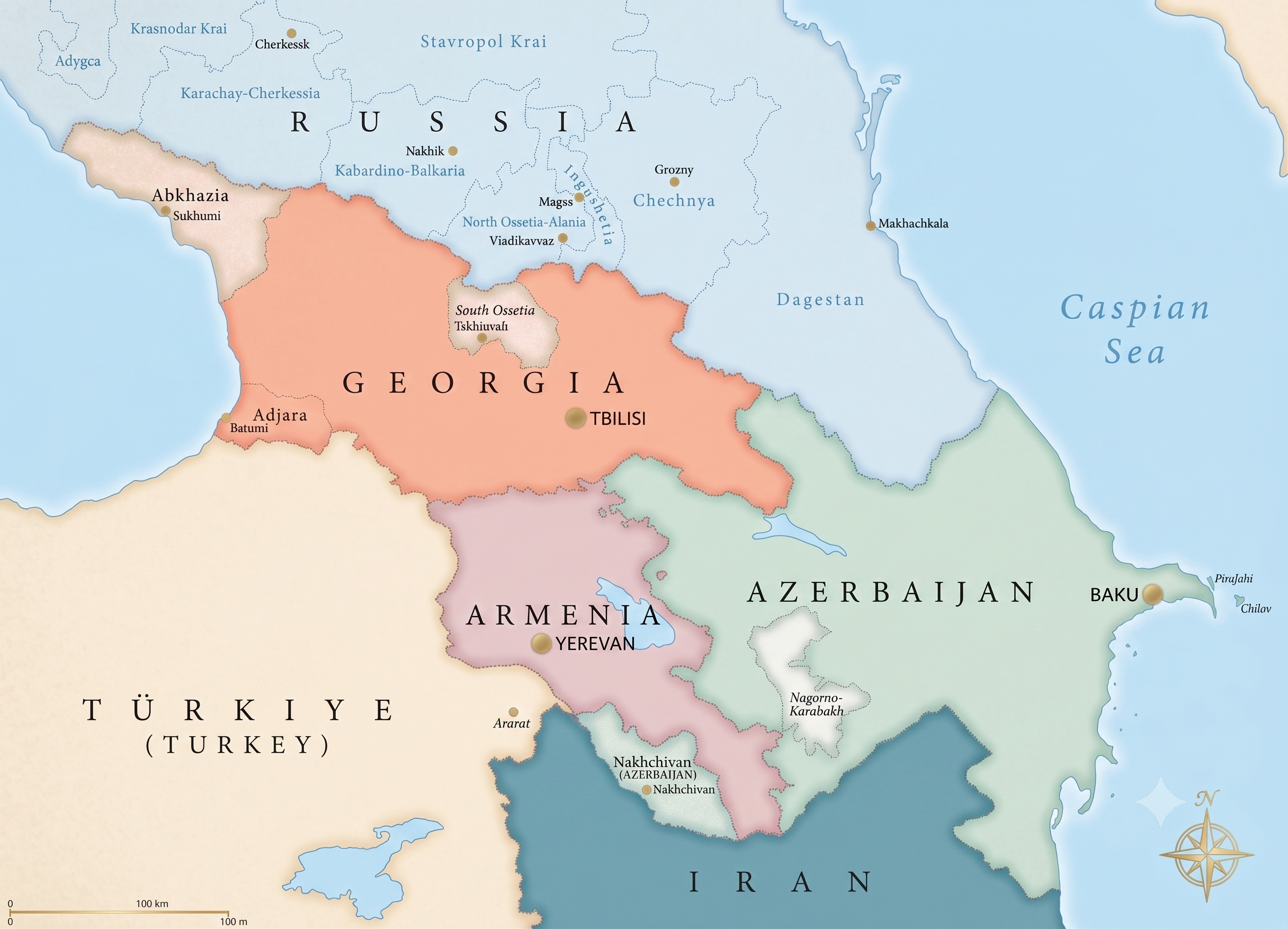
For nearly thirty years, Nagorno-Karabakh was the archetype of this purgatory. When I first looked into this subject in 2020, the war had resumed with great violence: the flare-up that occurred between September and October of that year ended with a dramatic toll of roughly 5,000 dead and 30,000 displaced. At the time, Europe was culpably absent, paralysed by the urgency of Covid and oblivious to the rest of the world, while the United States seemed trapped by the isolationism of the Trump presidency and distracted by its own domestic elections. The Western vacuum was quickly filled by Vladimir Putin, who imposed a peace plan signed in Moscow and guaranteed by the deployment of 2,000 Russian troops. At the time, the prevailing view was that it was unlikely the Kremlin would withdraw those troops once the agreement’s five-year term expired.
One could debate the Russian initiative to station a peacekeeping contingent in Nagorno-Karabakh without a formal mandate from the UN Security Council, as is usually the case. The operation was never ratified or extended multilaterally by other regional organisations, such as the OSCE; nonetheless, from the standpoint of international law, the legitimacy of the Russian military presence rested on the consent of the states concerned. The sole legal basis was the ceasefire agreement of 9 November 2020, signed jointly by the leaders of Armenia (Nikol Pashinyan), Azerbaijan (Ilham Aliyev) and Russia (Vladimir Putin). Against this backdrop, the rules of engagement remained uncertain, such that Russian forces stood — probably encouraged in this by Moscow — entirely idle in the face of Azerbaijan’s military intervention in 2023. When Baku ultimately withdrew its consent to the presence of foreign troops, the legal cover for the peacekeeping intervention disappeared, and, following a lightning offensive, Azerbaijan permanently liquidated the Armenian enclave.
From the standpoint of international law, it is legitimate to ask why Nagorno-Karabakh never managed to acquire international legal personality, with all the protective consequences that would have entailed. While it is established that the insurgents had achieved a degree of effective control over the territory — a necessary characteristic for claiming statehood — doubt remains as to why Artsakh was never elevated to the rank of sovereign state. It should also be recalled that no formal recognition ever came from other states, including Armenia, even though such recognition would in any case have amounted to nothing more than a political declaration devoid of binding international legal value. On the question of legal personality, Yerevan attempted to justify the enclave’s status by invoking the well-known 1986 International Court of Justice ruling in Nicaragua v. United States, arguing that Armenia’s role amounted only to logistical support rather than “effective control” over the independence movement.
However, in 2015, the European Court of Human Rights (ECHR), in Chiragov and Others v. Armenia, found that the Republic of Artsakh was not an independent entity but a territory under the “overall effective control” of Yerevan, which ensured its military, political and economic survival. Armenia’s regular armed forces had not confined themselves to protecting the enclave but had militarily occupied seven surrounding, entirely Azeri districts for the sole purpose of creating a security zone. This situation had led, as early as 1993, to the adoption of four UN Security Council resolutions (822 of 30 April, 853 of 29 July, 874 of 14 October, and 884 of 12 November), demanding the immediate and unconditional withdrawal of all occupying forces.
Since Armenia was sending its own regular troops to guard the enclave’s borders, it appeared established that the two realities had become one and the same. Because of this original flaw, the international community, while condemning Baku’s intervention on humanitarian grounds, regarded it as formally legitimate as a means of restoring state sovereignty and ending an unlawful occupation. Moscow’s assured veto blocked the adoption of any condemnatory resolution at the Security Council; as a result, the diplomatic response was limited to statements from the Council of Europe and the European Parliament, with no concrete effect. The European Commission and Council, for their part, adhered to a strict Realpolitik grounded in strategic dependence on gas supplies from Baku.
A Realpolitik also pursued pragmatically by Vladimir Putin, who, without much regret, abandoned Armenia to its fate, redirecting his interests toward the Azerbaijan-Turkey axis (with Erdoğan cast in the role of Aliyev’s patron). Moscow sacrificed its old ally on the altar of the support and logistical and economic channels it was receiving from Ankara in the midst of the war in Ukraine. It did Yerevan little good to turn hastily toward the West in the hope of replacing its alliances, diplomatic backing and military supplies with substitutes for those Russia had now withdrawn.
Territorially, administratively and legally, Nagorno-Karabakh is today fully reincorporated into Azerbaijan: it enjoys no autonomy relative to the rest of the country, and Baku’s government applies Azerbaijani constitutional law across the entire former enclave, now officially redefined as the “Karabakh Economic Region.” Historic towns such as Stepanakert (renamed Khankendi) and Shusha are under tight state control. The Azerbaijani government is moving rapidly forward with its “Great Return” programme, rebuilding strategic infrastructure (roads, tunnels, power plants) and repopulating the region with Azerbaijani citizens in place of the more than 100,000 Armenians who fled in 2023.
For Nagorno-Karabakh’s former inhabitants who took refuge in Armenia, a situation has emerged that it is no exaggeration to call Kafkaesque. Those who, for decades, had used special Armenian passports bearing the code “070” were told that these documents did not amount to full citizenship, forcing them to undergo formal naturalisation procedures in order to be integrated into the Republic of Armenia. Accepting full Armenian citizenship, however, entails losing refugee status and any international legitimacy to claim a future “right of return” or restitution of property. Given that the odds of such a right of return materialising are close to zero, those who chose to refuse naturalisation would be left in a permanent and precarious state of statelessness within Armenia.
Along with the refugees who fled, the government then headed by Samvel Shahramanyan also dissolved, after he signed the decree dissolving all institutions effective 1 January 2024. Later, once safe, Shahramanyan declared the document null and void, claiming it had been extracted under armed threat from Baku. The original idea was to maintain a government-in-exile based in Yerevan, but these authorities — now led by Ashot Danielyan — are not even recognised by Armenia itself, which views their presence as a dangerous obstacle to concluding a definitive peace treaty with Azerbaijan. On this basis, Armenian courts have approved the seizure of properties linked to the government-in-exile, and Artsakh’s Permanent Representation in Yerevan has itself been the subject of government expulsion decrees.
The parable of Nagorno-Karabakh thus leaves behind a stark and disillusioned lesson about the state of contemporary international relations. For thirty years, Artsakh was the archetype of the “phantom state,” a legal and ethnic island suspended between the principle of effectiveness and diplomatic isolation. Its disappearance, which produced a humanitarian catastrophe with the erasure of a millennia-old human presence, has its roots in an indisputable truth: the primacy of particular interests that drive geopolitics. Nagorno-Karabakh’s fate was sealed by a Security Council paralysed by crossed vetoes, a European Union torn between the demand for humanitarian protection and the vital interest of energy supply, and a tangle of interests binding Russia and Turkey together in an exchange of favours spanning the Caucasus and the war in Ukraine. With Putin’s pivot from Armenia to Azerbaijan, Artsakh found itself the clay pot caught between two iron pots. And, in the end, it was smashed to pieces.