Paolo Borioni
The Danish government agreement, reached with great difficulty, includes four parties in the executive. Two are centrist, but the other two, which are larger overall, belong to the socialist tradition (the Social Democratic Party, which holds a relative majority, and the Socialist People’s Party, which emerged from the elections greatly strengthened). However, the government will also need external support from a post-communist party list (which has also grown considerably) and from the environmentalists, who have only just surpassed the 2% electoral threshold. The Social Democrats must recover from an electoral decline of around 5%, which also reflects a degree of dissent towards them, both in public opinion and, certainly, within the trade union movement. This will not be easy in the context of the growing party fragmentation that characterises Danish democracy.
Nevertheless, an important signal appears to be emerging: the government will seek to strengthen the historic confederated trade union movement within the traditional autonomy and symmetry between the parties that characterise Nordic industrial relations. Recently, in fact, within this system the so-called “yellow” unions (the main ones being the Christian-inspired Krifa and Det Faglige Hus) have made significant inroads among Danish workers. Indeed, in a system where around 70% of workers are still unionised, the historic confederated trade union movement now represents only slightly more than 50% of them. The latter, which brings together a very widespread network of workplace union representatives as well as around 80 sectoral and occupational unions, was once known as LO, as in the other Scandinavian countries.
Today, after a series of mergers that have partly diluted its socialist and class-based character, it is known as FH (an acronym for the Central Trade Union Organization). Nevertheless, it is still capable of making its voice heard—and of exerting influence through its funding—over the parties that emerged from the labour movement. It is therefore significant that the government preparing to lead the country has decided to allow only workers belonging to the confederated trade union FH to deduct their union dues from taxable income. This is because the “yellow” unions compete primarily on price. They are able to do so because they essentially provide only various forms of individualized services, without maintaining a presence in workplaces and therefore without being able to credibly claim to represent the workforce as a whole in either national or local collective agreements. The “yellow” unions can also undercut prices because they do not maintain strike funds, an essential feature of the Nordic model of class compromise (and one that should urgently be established within CGIL and beyond). This further exposes their identity as pseudo-unions that avoid industrial conflict.
Among the proposals is one put forward by the post-communists, who envisage a rather unusual legislative intervention for the Nordic systems: defining in law what qualifies as a trade union and what should instead be regarded as another legitimate type of association. In any case, it is no coincidence that the “yellow” unions recruit most of their members at the two extremes of the labour market: at the top, among professionals who believe they can do without collective agreements based on solidarity and universal coverage; and at the bottom, among workers in sectors such as hotel and hospitality services, where national agreements provide limited coverage and where high labour mobility makes it difficult to develop a stable class identity—or even a lasting occupational identity.
Krifa and Det Faglige Hus began to expand following the reforms introduced by the “bourgeois” government in 2002. Those reforms allowed them to establish union-linked unemployment insurance funds—characteristic of the Nordic Ghent system—even on a multi-occupational basis, despite the fact that these organizations did not seek to negotiate national collective agreements or represent workers across the entire country. With its current reform proposal, the newly formed government is attempting to restore the balance. This has political motivations—not least avoiding the complete erosion of the still-existing relationship between FH and the Social Democrats—as well as ideological ones. The “yellow” unions do not promote a conception of society in which compromise and conflict are complementary; instead, they offer individualized services suited to a fragmented society that they simultaneously—and rather contradictorily and instrumentally—portray as harmonious. The decision is also motivated by a desire to preserve a system which, despite its setbacks, still functions better than most alternatives. Strengthening those who seek to place limits on the ability of Nordic capital to compete through the intensive exploitation of labour brings all these considerations together. It also serves to mark a break with the previous, overtly centrist legislature, which proved damaging above all in electoral terms. Indeed, the course and outcome of the complex negotiations that led to the formation of the Danish government confirm one thing above all: Macron-style centrism (an approach also attempted by Renzi and a number of other habitual imitators) does not work—not even in a parliamentary system based on proportional representation.
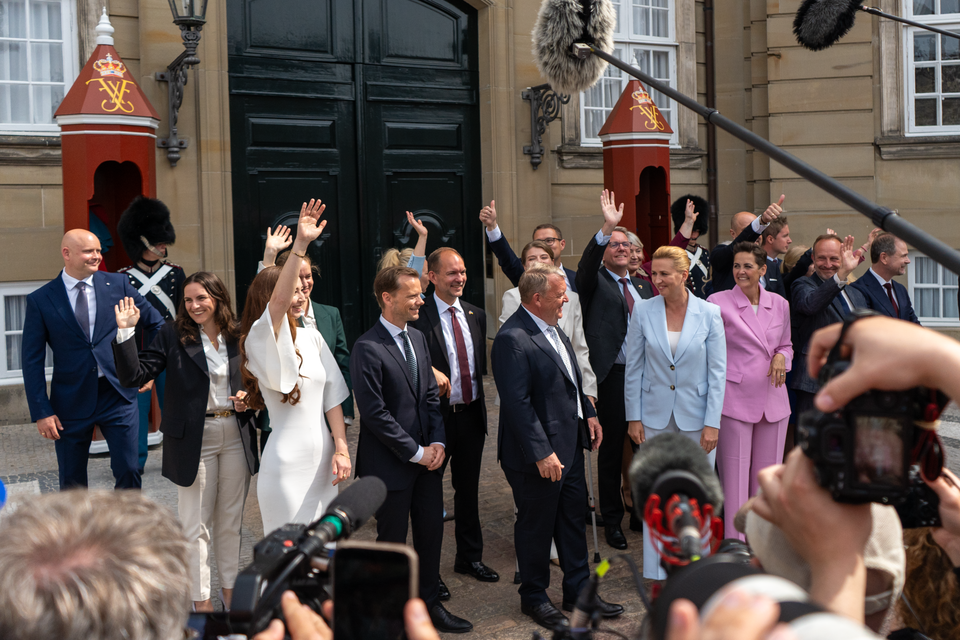
Its idea of simplifying and excluding the complexities of real political dynamics no longer works in these times of socio-economic decline—not even in Europe’s strongest economy. That is, not even in Denmark. Yet this had been the plan of former Liberal Prime Minister Lars Løkke Rasmussen, who during the previous legislative term had brought the Social Democrats and the liberal-agrarian Venstre into government together with his own Moderates party, creating an executive that was doubly unusual: both a majority government and a centrist one. In other words, it excluded both the nationalist-populist right and the socialist left. Today, although the programme and future course of the new government in Copenhagen remain full of uncertainties, Løkke Rasmussen has had to accept precisely what he once admitted was one of his nightmares: a minority coalition sustained by the support of “the central committee of Enhedslisten,” the post-communist Red-Green Alliance led by Pelle Dragsted. In government he will have to work alongside ministers from the Socialist People’s Party, the Social Liberals, the Social Democrats, and, of course, the Moderates. He will also have to secure the support of the environmentalist Alternative. The government will once again be headed by Mette Frederiksen, even though the Social Democrats performed poorly in the election, as did all three parties involved in the previous centrist experiment, with their vote share falling from 27 to 22 per cent.
Nevertheless, in an extremely fragmented parliament (with twelve parties represented), the Social Democrats remain twice as large as any other party and, for that very reason, are indispensable to virtually any conceivable coalition. The very strategy on which Løkke Rasmussen had founded his party—to win around 10 per cent of the vote and thereby force the liberal-agrarians and the Social Democrats to form governments independent of influence from the political extremes—ended up consuming itself within just a few years. No amount of negotiating gymnastics, during the more than two months of exploratory mandates granted by King Frederik X (first to Frederiksen and then to the liberal-agrarian Troels Lund Poulsen), could overcome the simple reality of a strengthened socialist and post-communist left, alongside nationalist-populist parties (three of them now represented in parliament with around 20 per cent of the total vote) that would not only be indispensable for the formation of any centre-right government, but of which the Danish People’s Party has even placed a veto on the participation of the Moderates themselves. As a result, the Moderates have been forced to abandon the very rationale for their creation.
In fact, the electoral drubbings suffered by the Social Democrats even before the recent general election had already led the largest party in parliament to return to policy positions conducive to cooperation with the post-communists and the Socialist People’s Party. This began with an election campaign centred on equality, even including a wealth tax which, even if it is not ultimately implemented in a systematic form, has certainly not disappeared without leaving its mark. Indeed, when asked a specific and persistent question by journalists about the programme currently being negotiated—“Will this government make us a more equal society?"—Mette Frederiksen answered without hesitation: “Yes.” The more interesting question, however, is this: what significant, ambiguous, and contradictory elements lie behind that statement? It should be said at once that, as was only to be expected, the Moderates had to be granted programme commitments capable of withstanding criticism from the Liberals, Conservatives, and nationalist-populists in opposition (who find themselves there also because, unlike in Italy or France, the Danish right consists of six fragmented parties that are less capable of forming coalitions than the left). For example, the corporate tax rate will be cut by 3 per cent—more than the parties of the right had proposed—although financial firms, which one might euphemistically describe as having a low labour intensity, will not benefit from the reduction. The neoliberal argument linking lower taxes on certain labour incomes (particularly those between DKK 641,200 and DKK 777,900, earned by managerial and highly skilled professionals) to a greater willingness to supply labour has also been accepted to a considerable extent, with taxes on that income bracket being modestly reduced. As for the very highest incomes, a compromise has been reached: a substantial increase in the additional tax, but the elimination of a previously planned supplementary levy on incomes above DKK 2,818,152.
Despite all this, the parties of the labour movement have nevertheless secured tangible signs of a renewed commitment to the universalist path in welfare policy—that is, the principle that services should be available to everyone and financed exclusively through the proceeds of progressive taxation. One example is the immediate introduction of free dental care for pensioners receiving the minimum pension and for other disadvantaged groups, alongside a plan to extend free dental care to the entire population within a decade. This is an achievement that the leader of the post-communists has celebrated in particular. Another significant universalist breakthrough, although for the time being less clearly directed towards future expansion, is the introduction of free public transport for everyone up to the age of 22. This offers a glimpse of two longer-term objectives that, if realised, would be genuinely historic:
public transport being established as a universal public service, like education and healthcare;
free public transport as perhaps the quickest means of reducing harmful emissions and planning an economic and industrial transformation of the automotive sector.
This also reflects the presence within the governing majority of far more radically environmentalist forces: the ecosocialism of the Socialist People’s Party (SF), which is part of the government, and the libertarian environmentalism of Alternativet, which provides external parliamentary support. Hence the announcement that regulation of Denmark’s historically powerful agri-food industry will be accelerated and tightened, particularly with regard to the appalling treatment of the fifteen million pigs produced annually, but also concerning the use of chemicals harmful to rivers, fjords, and coastal waters. The agri-industry’s representative organisation immediately mobilised (significantly, through the Jutland daily Jyllands-Posten), forcefully arguing that the so-called “Green Tripartite Agreement,” concluded in 2024 with its own signature, should now be regarded as null and void. Thus, the Frederiksen III government immediately faces an important new front of conflict.
Returning to welfare, another way in which the Social Democrats had long prepared their exit from the self-defeating centrism of the previous legislature, while attempting to limit its political damage, is the idea that the retirement age cannot continue to rise indefinitely. Clearly, this principle is bound to provoke strong reactions. It is an issue over which the Social Democrats will have to contend within the government itself, particularly with the Moderates and the Social Liberals, while at the same time rebuilding consensus with the confederated trade union movement, the principal advocate of this proposal and, more generally, of policies aimed at reducing inequality. In any case, the coalition agreement has strengthened what had already been introduced in 2018 as the “Arne pension,” named after a real worker, Arne himself, whose body had been genuinely worn out after decades spent cleaning pig intestines. In short, those employed in physically demanding occupations will, like Arne, be able to retire earlier than others, with improved income guarantees.
Another attempt to rebuild credibility with the trade union movement—which in the Nordic countries still retains a remarkable capacity to shift both electoral support and financial resources—is the restoration of a public holiday, the Great Prayer Day, a Lutheran observance established in 1686 and abolished by the previous centrist government without even consulting the trade unions (thereby violating the Nordic model of collective bargaining) or the overwhelmingly dominant Church of Denmark, raising even theological and constitutional objections. It was precisely against this decision that the FH confederation mobilised, organising workplace activism intended to demonstrate that the labour movement remains a living force within society, even when it is exceptionally excluded from established negotiating procedures. Here, too, lies another qualitative difference from the “yellow” unions, which are almost entirely focused on providing inexpensive individual services and lack the identity of a “popular movement” in the broader historical sense.
In summary, one can speak of a compromise between supply-side neo-liberal incentives aimed at encouraging the demand for and supply of labour (arguments which, even if not entirely well-founded, nevertheless carry some weight in an economy characterised by an exceptionally high employment rate, low unemployment, and an extremely restrictive immigration policy) and measures designed to achieve immediate reductions in inequality as clearly and effectively as possible (which, as will become evident, also constitute factors supporting domestic demand). Within the latter category belong the additional DKK 1,000 per month for pensioners receiving the minimum social pension, and perhaps above all the increase in inheritance taxes, including the doubling of taxation on real-estate inheritances above DKK 10 million (a threshold that is not particularly high given the extraordinary values of the Copenhagen housing market). Also included are the lowering of the ceiling on deductions for interest payments (which affects most heavily the most expensive purchases and therefore the largest debts), and the move towards bringing taxation on high dividend and capital-income earnings closer to that applied to high incomes of other kinds. One of the greatest contributions to the immediate reduction of inequality will be the return—almost movingly traditional—to one of the basic principles of the labour movement: the fight against indirect taxation, especially on food consumption. Indeed, in order to combat rising prices, excise duties on fruit and vegetables will be abolished (which, in Nordic food culture, will also have effects on the average health of lower-income groups), while those on other food products will be halved.
Several commissions will ultimately be tasked with working on other issues of this kind which, according to disillusioned Nordic political jargon, have thus been “put in brine”—that is, set aside for preservation: partly to prevent the accumulation of tensions from further delaying the extremely complicated formation of the executive, and partly because these are genuinely complex questions. Among them is taxation on capital gains from property resales, which should (at least according to the left) identify new and more fairly selected sources of revenue, while also curbing property values which, at least in the major cities, have distorting effects both on one of the least justified forms of material inequality and on equal opportunities. In this sense, the issue also raises questions of economic efficiency: indeed, while it is true that Copenhagen and Aarhus in particular (like Stockholm and Gothenburg in Sweden) frequently attract the best students and workers, the material inaccessibility of housing is already probably limiting the optimal formation and availability of skills, and therefore the very growth potential of Nordic economies.
In conclusion, a few considerations. First of all, this new political and programmatic direction—which undoubtedly opens up new areas of spending or reduced tax revenue in many areas—could lead to a less obsessive pursuit of both budget surpluses and balance-of-payments surpluses. This would be very welcome news, but who knows whether it will happen. In any case, such a possibility can be inferred from the fact that experts are discussing a reduction in the so-called “fiscal space” (det finansielle råderum): that is, the accounting approach which pursues surpluses by covering every expenditure and maintaining the established welfare system in relative safety, but without fully adjusting spending increases to cover the demographic impact on welfare according to Nordic principles of high decommodification and universalism. These pressures include, above all, population ageing and rising technological costs in healthcare and psychiatry, but also the need for longer educational pathways for younger generations, as well as childcare institutions capable of supporting the increasingly indispensable participation of parents in the labour market and encouraging higher birth rates.
Furthermore, Frederiksen and her government’s explicit declaration of a desire to reduce inequality remains sufficiently rare to deserve attention. Could we ever imagine, in Italy or in much of Europe, an electoral and governmental programme so explicitly focused on this objective? The fact is that Nordic history (and, compared with the rest of the world, Western European history as well) demonstrates that, at least when understood as the elimination or strong limitation of exploitation, a high degree of equality continues to be impossible to avoid as a factor of efficient competition and more virtuous socio-political functioning. At the same time, the contradictions of social democracy today (and perhaps more generally of social democracy as a specific version of democratic socialism) have not disappeared with Mette Frederiksen’s new programmatic, coalition-building, and communicative phase. This is because the capacity to compete successfully precisely on the basis of the greater equality historically achieved has not subsequently been systematised into an internationalist and internationally oriented programme.
On the contrary, the tendency to pursue growth in an excessively export-oriented manner, rigidly embedded in EU rules, limits the ability of others to move closer to this type of social model. It erodes from within the only European model that is not regressive and is therefore acceptable, especially from a socialist perspective. This is why, despite frequent misunderstandings (and even deliberate manipulations), it is entirely incorrect to assume that internationalism and Europeanism are synonymous. Moreover, every export-led growth strategy ultimately and inevitably reproduces an erosion of equality even within the Nordic countries themselves. Therefore, Frederiksen’s current and explicit egalitarian choice is good news—but unfortunately it should not be a source of excessive enthusiasm.
- Note: Different versions of this analysis have been published in Italian in other newspapers and magazines.