Roberto Bertoni
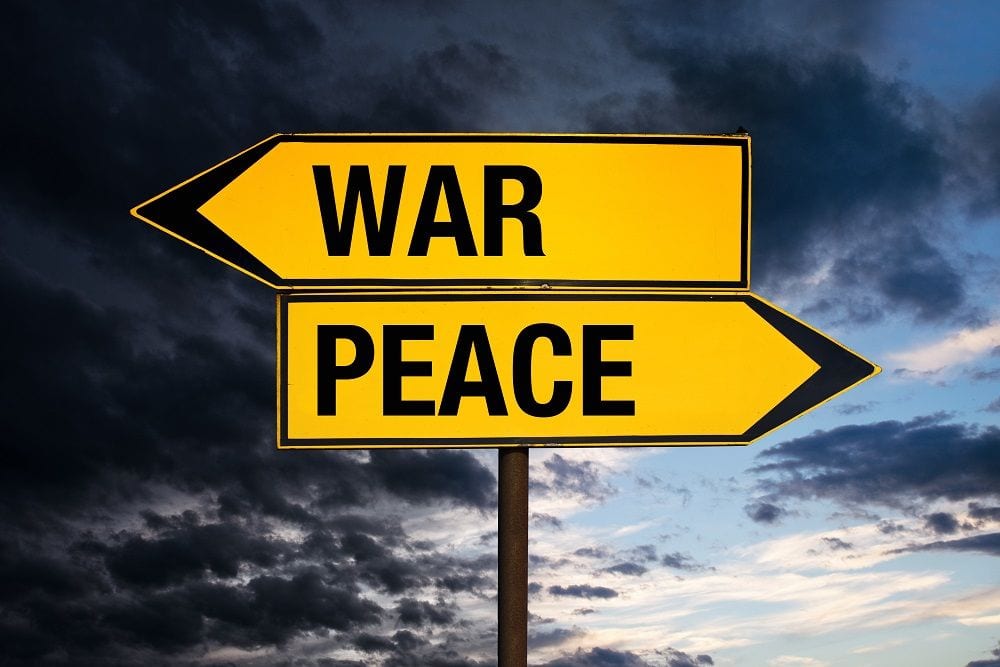
Let us hope we are wrong, that we are being too pessimistic — but watching the tragic affair unfolding between Iran and the United States, which at times takes on almost grotesque proportions, one gets the impression that the world no longer knows how to live without war.
And given how things have unfolded in Ukraine, with the continuation of the Russian occupation (let us not forget that Putin’s rise is also a consequence of globalisation’s limits and of the West’s betrayal of an honest statesman like Gorbachev) and Zelensky still ordering long-range missile strikes against Russian targets, along with the failure of any prospect of a truce after four years of conflict, the bitter feeling is that the Old Continent has slipped back to 1913 — the year of the “sleepwalkers,” those who drifted into barbarism without even realising it.
Yet one hardly needed to be an analyst to understand that the Belle Époque was nothing more than a magnificent illusion, with its parade of scientific progress, its world’s fairs of exceptional grandeur (the 1889 Paris exposition, for instance, gave us the Eiffel Tower), and the emergence of great new forms of collective organisation: political parties, trade unions, football clubs.
A shame that a century came to an end and the new one now demands its place, no longer tolerating crowned heads, old empires, or the rhythms and rules of a world that had run its course.
That is how irredentist movements emerged and spread, extending those of the Risorgimento, whose echo had never truly faded; that is how the Ottoman Empire and the Austro-Hungarian Empire desperately tried to resist their own disintegration; and that is how the trenches came about, the horrors, the hundreds of thousands of French and German victims around the Verdun stronghold, and the Italian victims on the Adamello, the Carso, the Bainsizza, the Tagliamento, and other places made grimly famous by the massacres that took place there.
On a planet with no order left, no centre of gravity, with the old hegemonic power turned isolationist once again and Europe — hegemonic for four centuries, having committed suicide between 1914 and 1918 — forced into a brutal awakening after thirty years spent under the illusion that History had come to an end, the monsters, alas, reappear.
And beware, for today we are breathing that same “phoney war” atmosphere, that Danzig-like mood, that waiting for catastrophe which inevitably leads toward the abyss, unless some event — for now unforeseeable — intervenes to calm tempers.
Add to this the fact that neither Netanyahu nor Zelensky has any interest in seeing an end to the conflicts that guarantee their hold on power, that Putin has turned the politics of domination and strength into a veritable existential brand (ever since the massacres in Chechnya, back when many Western observers idolised him), and that Trump is incapable of engaging in any geopolitical discussion without lapsing into a ridiculous, blustering Captain Fracasse routine — and what lies before us is the grim picture of a world standing at the edge of the abyss and, it would seem, wanting to plunge in.
After all, for the merchants of death and the fetishists of GDP (two categories that often overlap), every catastrophe is a windfall: the United States, thanks to the Second World War, was able to turn the page on the 1929 crisis and establish itself as the dominant nation, not least thanks to the atomic bombs dropped on Hiroshima and Nagasaki.
The same held true for Hitler’s Germany, which climbed out of the hell it had been plunged into during the Weimar Republic largely by building up its military industry.
Guns are shameful, but they are not unproductive, and those who make decisions at the summit of world power are in the habit of reasoning with their wallets and letting themselves be guided by their own interests — certainly not by sentiment.
The question is whether, once the road to war has been travelled to its end, there will still be an Earth left on which they can try to exercise their ambitions.