Eric Djabiev
Total control over the country
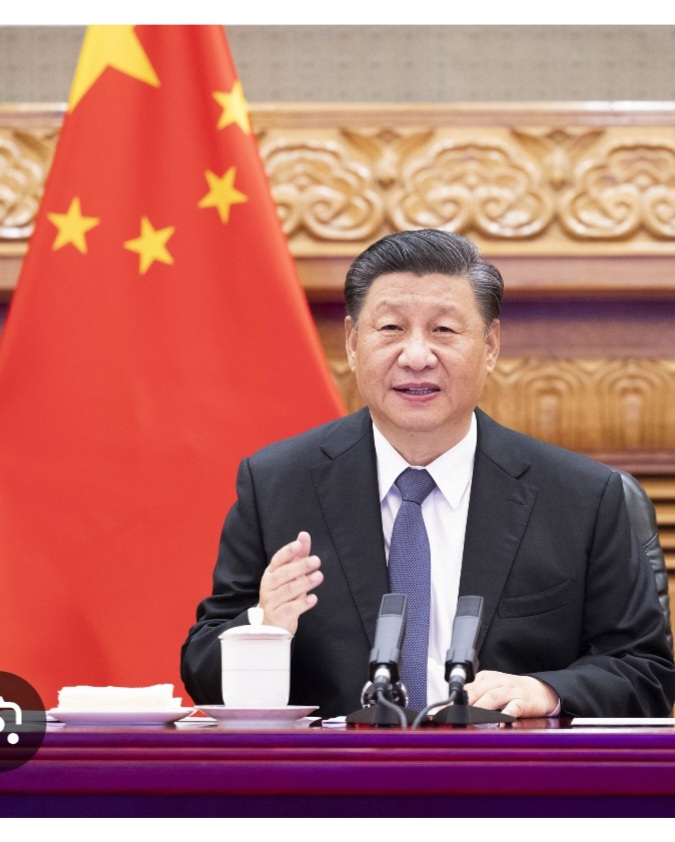
Having come to power in 2013, Xi Jinping leads a state that, over thirty years, became the world’s second-largest economic power.
The economic successes of the People’s Republic of China date back to 1978, when Deng Xiaoping imposed his programme of economic reform and opening to the world — the “Open Door” policy. Under the Maoist era, the Chinese economy had collapsed under a Stalinist-style, highly authoritarian planning system. Deng is the founding father of China’s new economic power. Under his leadership, over thirty years, China emerged from underdevelopment, driven by 10% growth throughout that period. The growth model has, since 1980, been based on the five Special Economic Zones (SEZs). An SEZ is located on the coast, since it is export-oriented — exports having become the true engine of the Chinese economy. Shenzhen’s is the most significant. The SEZ has a derogatory legal status as a free zone, operating according to free-market rules. Its purpose is to attract foreign investors and to conduct joint ventures with foreign firms. In exchange for very low labour costs, technology transfers are mandatory. These transfers have been essential to China’s climb up the technological and value-added ladder — what is known as “reverse engineering.”
Within a framework of authoritarian planning, a Chinese-style state capitalism thus emerged, one that leaves economic actors a degree of autonomy. These economic successes have allowed China’s central power to silence all opposition, both within the Communist Party and in civil society.
In fact, Xi Jinping has broken with the rules set by Deng Xiaoping: two-term limits, collegial leadership, and the ban on the cult of personality that had existed under Mao. Xi has rehabilitated Mao, a figure who remains popular. For the Chinese, Mao remains the hero and victor of the war of liberation. There is a certain nostalgia — not for the Terror, but for social equality and the absence of corruption. In any case, the Chinese regime forbids any mention of the famines and violence of the Cultural Revolution.
Through his 2018 constitutional reform, Xi secured his position as president for life, with no term limit. Where Deng had wanted a more open Communist Party, Xi has installed highly authoritarian practices of absolute power. He has strengthened the totalitarian character of the Chinese regime. Yet Deng and Xi are aligned on one point: the bloody repression of the students gathered in Tiananmen Square in 1989. Deng was behind the martial law that made that massacre possible. Chinese economic liberalism does not tolerate political liberalism — it represses it. To purge the CCP, Xi has used the fight against corruption, a campaign that is also highly popular. Since 2013, from the moment he came to power, he has waged a campaign against corrupt Communist officials. He has attained an unrivalled level of power, positioning himself in the footsteps of Mao and of the popular Han dynasty.
Xi Jinping has built an unmatched system of mass surveillance
Chinese civil society traditionally experienced “social movements.” Under Xi Jinping, such movements have become impossible. The Chinese state has taken total control of civil society, in keeping with the country’s very strong tradition of controlling the population. The regime has established generalised mass surveillance through a network of roughly 700 million AI-enhanced cameras using facial recognition. These cameras are concentrated mainly in major urban centres. The argument is always the same in totalitarian systems: “the safety of citizens.” But in China, there is a permanent fear of a mass uprising driven by economic and social causes — an economic crisis, a war…
An actual war waged by the Chinese regime is unlikely, because unlike other totalitarian systems, which were autarkic, the entire Chinese model is built on exports. The domestic market still cannot substitute for foreign markets. Moreover, the Chinese have grown accustomed, over thirty years, to a certain standard of living; a return to the sacrifices of the Mao years would not be accepted. On top of this is a permanent rating system for every citizen — the social credit system — which originated in banking. Whereas banks rate their customers within a capitalist framework, in the People’s Republic the system has been extended to cover every aspect of private life. It became universal starting in 2020. It denies “bad elements” access to certain rights. For example, 11 million Chinese citizens have been barred from flying.
The system’s one weakness is that it must be entirely fair and transparent, free of any interference from potential corruption. In practice, this system is accepted under duress. In the People’s Republic, the internet is controlled by the state, which hunts down VPNs. Yet some Chinese citizens, marginally, manage to use VPNs. In Russia, nearly 50% of the population has VPNs, even though they too are pursued there.
The spread of Chinese-style totalitarianism into the liberal democratic world, through an illiberal drift, is dangerous for individual freedoms. These methods of social control are also spreading within liberal democracies, in the name of the fight against terrorism or against immigration. This reflects the fear among ruling elites of losing power or seeing it diminished. Fear then becomes a tool of governance.
One example among others: the Chinese currency, the yuan, has been fully digitised… There is practically no cash left in circulation in the People’s Republic. As a result, the anonymity of all transactions there has disappeared. The EU and its member states must remain highly vigilant regarding respect for human rights and privacy. Moreover, the drive to digitise everything leaves democracies more vulnerable to the very real danger of cyberattacks amid a coming, generalised hybrid war.
Richard Haass, head of an American think tank, warns of the illiberal temptations facing Western democracies in the face of what he calls the new “Gang of Four” — the coalition of totalitarian states around the People’s Republic of China, together with Russia, North Korea and Iran. This is why a lasting Russian failure would represent a significant blow to the regime, and an even greater one should the current Iranian regime collapse. As leader of the totalitarian camp, Xi Jinping wages an all-out struggle against the values of liberal democracy. Hong Kong’s treatment illustrates this perfectly. From 2018 to today, he has relentlessly and methodically dismantled every democratic check and balance there.
A recent new step in the total takeover of the last bastion of “resistance” was the dismissal, from 2023 to 2026, of nearly all senior military officers.
The People’s Liberation Army has been in a state of major crisis since 2023
The Chinese president, who also serves as General Secretary of the CCP, is likewise chairman of the Central Military Commission. This gives him total control over the army. In the People’s Republic, the army is as much a political force as a military one. Indeed, it was born in 1927 amid the civil war then pitting the CCP and its allies against the Nationalist government. The military high command was the last potential site of resistance to Xi Jinping. Just before the United States launched its attack on Iran on 28 February, Xi Jinping had, in January 2026, completed the dismissal of most of the PLA’s senior officers. Is this a coincidence? From 2023 to January 2026, Xi dismissed nearly all senior officers, particularly in the nuclear and equipment fields. General Zhang Youxia, the PLA’s highest-ranking officer and a close ally of the Chinese president, was likewise removed. The pretext used is always the same: corruption.
How can such a situation be explained, one that at first glance runs counter to the country’s interests? The example of Stalin’s “Great Terror” of 1937–1938 offers a first explanation. At that time, Stalin had most of the Red Army’s senior officers massacred, fearing a coup by his generals. Xi Jinping feared that in 2027 — the PLA’s 100th anniversary — a coup by his generals might overthrow him just as his fourth presidential term, set for 2027, approaches.
These two examples show the fragility of dictators who have emptied out the space around themselves… always at the mercy of a coup. Another explanation offered is that Xi seeks to heighten the general climate of fear, in order to exert even tighter control over the entire state apparatus and forestall any opposition. In May 2026, two former defence ministers, both former generals, were effectively sentenced to life in prison. To be sure, the PLA has never been more powerful. Its military budget is the world’s second-largest, though three or four times smaller than the American budget, depending on whether one factors in Trump’s new spending requests. Conversely, questions remain about the PLA’s potential weaknesses. An army stripped of its senior officers is greatly weakened.
Beyond that, China is undergoing a major demographic crisis. Its population is shrinking. Official figures put the population at 1.4 billion, but some experts estimate the country now has only 900 million inhabitants, if the fertility rate figure of 1.7 between 2000 and 2020 is accurate. The prevailing hypothesis is a kind of resistance by young people against totalitarianism: having only one child. Added to this are the cost of education, inadequate pensions, youth unemployment and a severe housing crisis. The demographic crisis is thus also affecting the army.
Finally, the Chinese army has no experience of “power projection or high-intensity conflict,” unlike the American, Russian, Ukrainian and also French armed forces — though the latter’s units remain very limited in number.
(Episode 1 – to be continued)