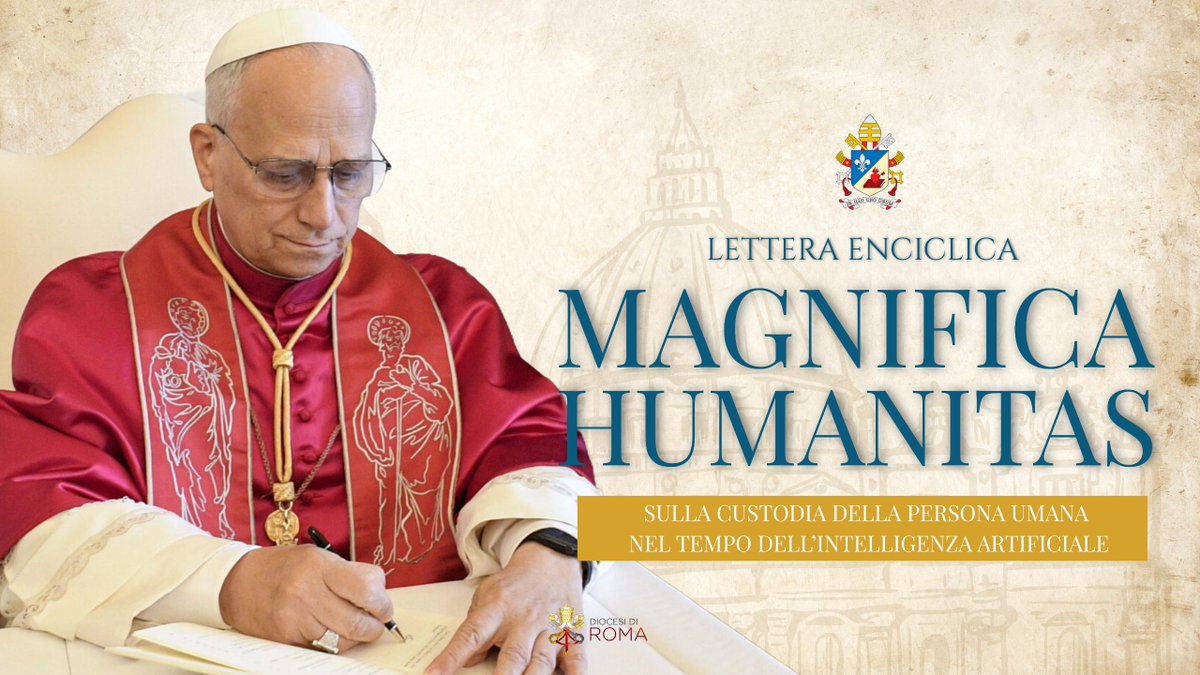
Artificial intelligence is but one of the ‘new things’ of our time. Just as in 1891 there was *Rerum Novarum*, about which Leo XIII wrote. At the heart of *Magnifica Humanitas*, Prevost actually places ‘the Social Doctrine of the Church’, which he regards as ‘a living body of truth’. The Pope sees no conflict between the encyclical of his namesake, who condemned the exploitation of children in factories but above all defended private property against the capital-labour conflict, and *Fratelli tutti*, in which Francis instead downgrades property to a ‘secondary natural right’, and *Laudato si’*, where he maintains that we have received the earth on loan not from our parents but ‘from our children’. There would also have been continuity between Pius XI, who had ‘Mit Brendenner Sorge’ – a condemnation of the idolatry of Race, the People and the State – read out in German churches and who, on his deathbed, was preparing an encyclical against Nazism, and his successor Pacelli, who, as Pope, never uttered Hitler’s name even in the face of evidence of the extermination camps, whilst in 1949 he excommunicated Italian communists and trade unionists guilty of seeking to requisition ‘uncultivated and poorly cultivated land’.
Furthermore, no break between Ratzinger, who advocated “the promotion of the common good”, and Wojtyla, who, in *Centesimus Annus*, celebrated the collapse of the USSR, opening the door to market theorists such as Michael Novak, Richard Neuhaus and George Weidel, who would go on to inspire Trump. It is not unusual for a Pope to quote and interpret his predecessors. Francis attributed to Wojtyla certain choices that were close to his heart. Paul VI did not set *Populorum Progressio* in opposition to *De Rerum Novarum*. Leo admits, moreover, that the “harmonious development” of social doctrine “has not always been linear” and that “communal discernment” is required. Nevertheless, the choice he makes is not neutral. It was Leo XIII, Pius XII and John Paul II who asserted the unified character of the Church’s social doctrine, founded ‘on Sacred Scripture and Tradition’. Leo is a restorer. He wishes to restore the unity – perhaps a new and different one – of the Sancta Romana Ecclesia. This comes after two pontificates that spoke more to the world than to the flock. It is no coincidence that he addressed those who traffic in human beings with the very phrase, “repent”, which Wojtyla once cried out to the mafia. Let those who traffic in human beings and the mafia remain amongst the faithful, provided they kneel and promise to change. Francis had excommunicated them. He preferred to speak to the Good Samaritan, to the Grand Imam of al-Azhar, or to ring his parishioners in Gaza in the evenings whilst they were under Israeli bombardment.
I find it curious that the majority of commentators have overlooked ‘the context’ in which the Pope frames his analysis of ‘artificial intelligence’. His interpreters will say that Leo’s social message is just as strong as that of Francis. Indeed, in the encyclical, the Pope asks for forgiveness for colonialism, for “the enormous suffering and humiliation that slavery has meant for so many people”; he condemns the theory of “just war”; and he argues that GDP should no longer be used as a measure of human development. He describes the deportation of millions of migrants as a “tragedy”. He reminds Trump that “America is a nation shaped by immigrants”. And he reminds European heads of state that they have failed to act to stop the massacre in the Mediterranean Sea. In short, Leone is popular because he is political and American, yet different from Trump.
Let’s get straight to the point. When discussing artificial intelligence, the Pope contrasts two biblical parables. The Tower of Babel, a symbol of human hubris that reaches up to God. And the building of the Temple in Jerusalem, led by Nehemiah, a Jew and official of the King of Persia. Contemptuous pride versus collective endeavour. Under the Tower of Babel, he places ‘transhumanism, which “enhances the human being through technology”, and “posthumanism, which envisages a sort of hybridisation between man, machines and the environment”. Nehemiah, on the other hand, teaches the Jews to build the Temple together, and with the Temple that ‘civilisation of love’ of which Paul VI spoke. Artificial intelligence is not the devil’s chaff. It can enrich humanity, provided a clear distinction is maintained between the ‘intelligent’ processing of data and the bodily nature of man created by God. A human being who finds strength in ‘limitation’. And in ‘suffering’ the impetus for compassion and forgiveness. ‘To completely suppress pain,’ writes Prevost, ‘one would also have to extinguish love and desire.’ A machine does not suffer and cannot forgive.
“Disarming Artificial Intelligence”. This is the encyclical’s strongest proposal. “To remove it from the logic of armed competition, which today is no longer merely military but also economic and cognitive”. “Small, highly influential groups,” the Pope warns, “can steer information and consumption, influence democratic processes and shape economic dynamics to their own advantage”. He adds that “control over platforms, infrastructure, data and computing power is no longer the preserve of states but of major economic and technological players who, in effect, set the conditions for access, the rules of visibility and the very possibilities for participation”. It is therefore necessary to “educate” people about AI, to counter “distorted narratives” that “blur the boundaries between truth and falsehood”. And, in schools, to counter the perception that it is easy to “achieve results”, the impression of AI’s objectivity and the simulation of human communication”. Naturally, the Pope defends work against robots, which, he explains, is the very source of human dignity.
These are excellent intentions, but how can they be pursued if Social Doctrine forbids tackling the crux of the issue of ‘ownership’ of data and data-processing procedures? Will Leone ask Peter Thiel, Elon Musk and Sam Altman to change their ways? Those who privatise data and DNA research, and seek to patent medicines capable of turning degenerative diseases into chronic conditions and ensuring long-term profits, are not aiming to identify the causes of illness and eradicate them. The (often truly idiotic) artificial intelligence of social media hunts for sensitive data, offers it to its master, and sells it. Meanwhile, it reinforces the views and prejudices of its followers, pitting them against one another in a sort of chaos that allows a handful of capitalist demigods to influence states and international relations.
I would have preferred Leone to have used the metaphor of the Golem – the non-human being who, if you give it a name, becomes superhuman. Because I see in this legend the disorientation of the Abrahamic religions in the face of AI. Man playing God and the non-human with human form are inherent to Western monotheisms. The Chinese are no better than us, but they treat artificial intelligence as a useful piece of infrastructure – decidedly non-human, yet capable of managing supply and the urban-rural relationship. Open source, because it is a waste to privatise discoveries. And ultimately, it doesn’t help business.