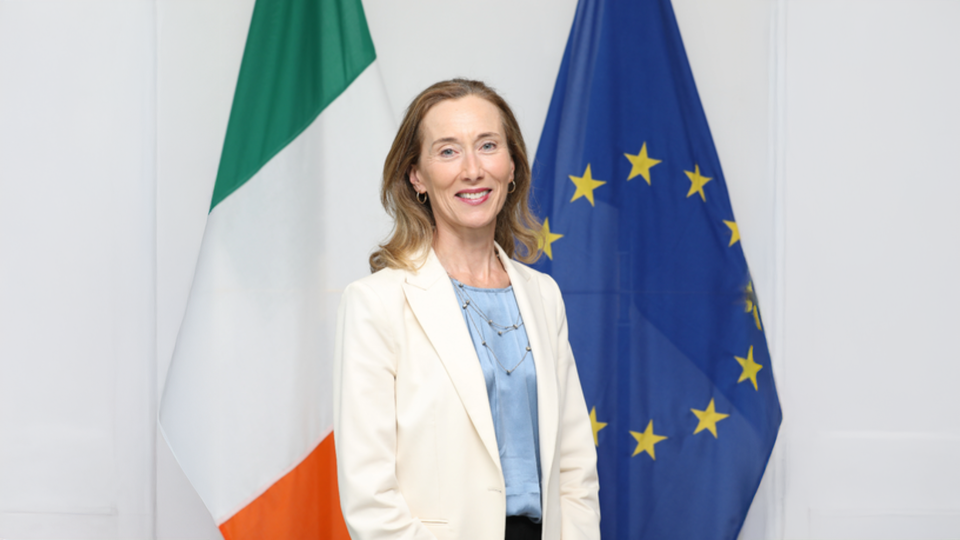
Interview by Maurizio Donini
Ambassador McCullough, Ireland takes on the Presidency of the Council of the European Union at a particularly complex moment. What political vision will guide the Irish semester, and what will be the main priorities of your programme?
During our presidency, we want to focus on delivering tangible improvements for citizens across the European Union. We are therefore prioritising three major thematic pillars: competitiveness, values and security. These pillars are closely interconnected and mutually reinforcing; they will guide every aspect of our work as the presidency.
Through our work on competitiveness, we hope to help strengthen the single market, remove barriers to internal trade, support European businesses and SMEs in expanding across the continent, and improve their access to the financing that will allow them to grow.
Through our focus on values, we will ensure respect for fundamental rights and concentrate on those most in need of protection.
On security, we know that no country, acting alone, can face the full range of security challenges, whether existing or emerging, by itself. The Irish presidency will actively contribute to the continued development of EU security and defence, because a more coordinated Union is less vulnerable to shocks, whether energy-related, economic, technological or geopolitical.
The Irish presidency opens a new trio of presidencies. What long-term goals have you set with your trio partners, and what mark does Ireland hope to leave over the next eighteen months?
We have worked with our trio partners, Lithuania and Greece, to develop a trio programme that will ensure a coherent approach to the Council’s work over the next eighteen months. From Ireland’s Atlantic coast, through Lithuania’s Baltic region, to Greece’s gateway to the Mediterranean, this trio of presidencies reflects the strength and the soul of the European project: different histories, experiences and perspectives, united in diversity and brought together around shared responsibility and a common purpose. We will focus on three thematic pillars: a free and democratic Europe; a strong and secure Europe; and a prosperous and competitive Europe.
During our presidency, Ireland will place particular priority on negotiations over the next multiannual financial framework; on implementing the “One Europe, One Market” roadmap, which aims to simplify rules, promote dynamic trade, address energy prices and decarbonisation, and advance digital transformation and artificial intelligence; on supporting fundamental rights; and on contributing to the continued development of EU security and defence.
Competitiveness, innovation and digital transition are at the heart of the European debate. What concrete initiatives does the Irish presidency intend to promote to strengthen the Union’s ability to compete globally?
We believe we can make a difference by improving the European Union’s economic competitiveness through the implementation of the “One Europe, One Market” roadmap. We are confident we can achieve significant progress during our presidency.
The roadmap aims to advance 42 proposals, which make up the five strategic pillars of competitiveness: (i) simplifying rules; (ii) creating a more integrated single market, notably by removing barriers to the internal market; (iii) promoting dynamic trade; (iv) reducing energy prices and advancing decarbonisation; and (v) promoting digital transformation and artificial intelligence. All of this has given us a clear work programme for the months ahead.
The roadmap aims to secure adoption of 20 of these proposals by the end of 2026, while for many others we will need to make substantial progress so that we can hand them on to our Lithuanian colleagues at the end of our presidency.
We have made achieving these goals a key outcome of our presidency, and we will continue to prioritise negotiations on these files. Naturally, we will rely on the engagement of the member states, the European Parliament and the Commission to reach these ambitious goals we have set together.
In an international context marked by geopolitical tensions, the war in Ukraine and challenges to European security, what role should the Union take on in your view, and what will be the Irish presidency’s foreign policy priorities?
The international security context has changed radically over the past decade, and the need to adopt measures to strengthen European security and build up our resilience has never been more evident.
Partnership will remain at the heart of our approach to security and defence, and cooperation with our closest partners reflects a concrete approach to tackling shared security challenges. In an increasingly contested security environment, structured action between the EU, NATO and their partners, together with ongoing cooperation with the UN and the OSCE, is essential to strengthening interoperability, resilience and the protection of shared interests.
Maintaining political, military and financial support for Ukraine, imposing severe sanctions on Russia, and continuing Ukraine’s EU accession process will be priorities for the Irish presidency. The fundamental principle that borders cannot be changed by force must be upheld. We will also promote active engagement in favour of lasting peace and security in the Middle East, particularly in the conflict between Israelis and Palestinians, reaffirming the EU’s commitment to the two-state solution. We will likewise support EU efforts toward peace, security and stability in Lebanon and Syria, as well as in the Gulf conflict, which has had significant repercussions at both the regional and global levels.
The Irish presidency will also prioritise the fight against hybrid threats, with particular emphasis on preparedness and strengthening the EU’s resilience against hybrid activities. We will work to strengthen the EU’s responses to cyber threats.
Enlargement to candidate countries is progressing alongside the debate on the Union’s institutional reforms. Do you think these two processes need to move forward together?
We see the enlargement process as a fundamental expression of our values, but also as an investment in the peace, security, stability and prosperity of our continent. We believe our fellow Europeans in candidate countries stand to benefit from the advantages of European citizenship, and that the Union as a whole will be strengthened by the contributions new member states can bring.
In particular, we will work to complete accession negotiations with Montenegro, seek to achieve substantial progress in negotiations with Albania, and continue negotiations with Ukraine and Moldova.
Over the years, I have had the privilege of interviewing former European Ombudsman Emily O’Reilly, who always stressed that protecting citizens’ rights and ensuring transparency in institutions were essential conditions for strengthening trust in the European Union. Ireland has a well-established tradition of attentiveness to civil liberties, the rule of law and good governance. How might this culture inspire the Irish presidency’s work and help strengthen the relationship between Europe and its citizens?
Indeed, as a country deeply committed to multilateralism, this is an area of particular importance for Ireland.
We are committed to upholding the principles on which the European Union is founded, including freedom, democracy, equality, the rule of law, and respect for human rights and dignity. We will work to promote these principles across the EU and in candidate countries, paying particular attention to strengthening the resilience of European democracies. We will also underline the importance of the EU’s global role, its contribution to the United Nations and its support for multilateralism, and we will work to ensure the Union uses its voice and influence to defend and uphold a rules-based multilateral order.
Italy and Ireland enjoy strong political, economic and cultural relations. In which areas do you currently see the greatest opportunities for cooperation between the two countries, particularly in light of the priorities of the European semester?
As you noted, Ireland and Italy share warm, long-standing ties. We cooperate closely within the EU and share values and positions on many issues. On competitiveness, for example, we are committed to fully unlocking the potential of the single market, and we will work closely with Italy and other EU partners on this file. We believe we can make a real difference in improving EU competitiveness through the implementation of the “One Europe, One Market” roadmap. Among the key shared priorities in this context are removing barriers to internal trade, supporting European businesses and SMEs in their expansion, and improving access to the financing that will allow companies to grow.
Simplifying EU rules is also a shared priority for Ireland and Italy. We see it as an essential component of efforts to strengthen EU competitiveness and reduce administrative costs, particularly for small and medium-sized enterprises, while maintaining ambitious environmental and other standards.
To conclude, what message would you like to send to Futuro Europa’s readers about the significance of the Irish presidency and the future of the European project?
Although the EU presidency may seem fairly technical to many citizens, it actually represents an opportunity for Ireland, working together with the other member states, to help shape the European agenda for six months: bringing countries together, chairing discussions, helping bring about agreements, and advancing files that matter to citizens across Europe.
We will be guided by an old Irish proverb, “Ní neart go cur le chéile,” which means “there is no strength without unity.” In today’s fragmented world, citizens face many challenges that no single country can solve alone. We must act together, in the interest of all.
First published on https://www.futuro-europa.it