Corradino Mineo
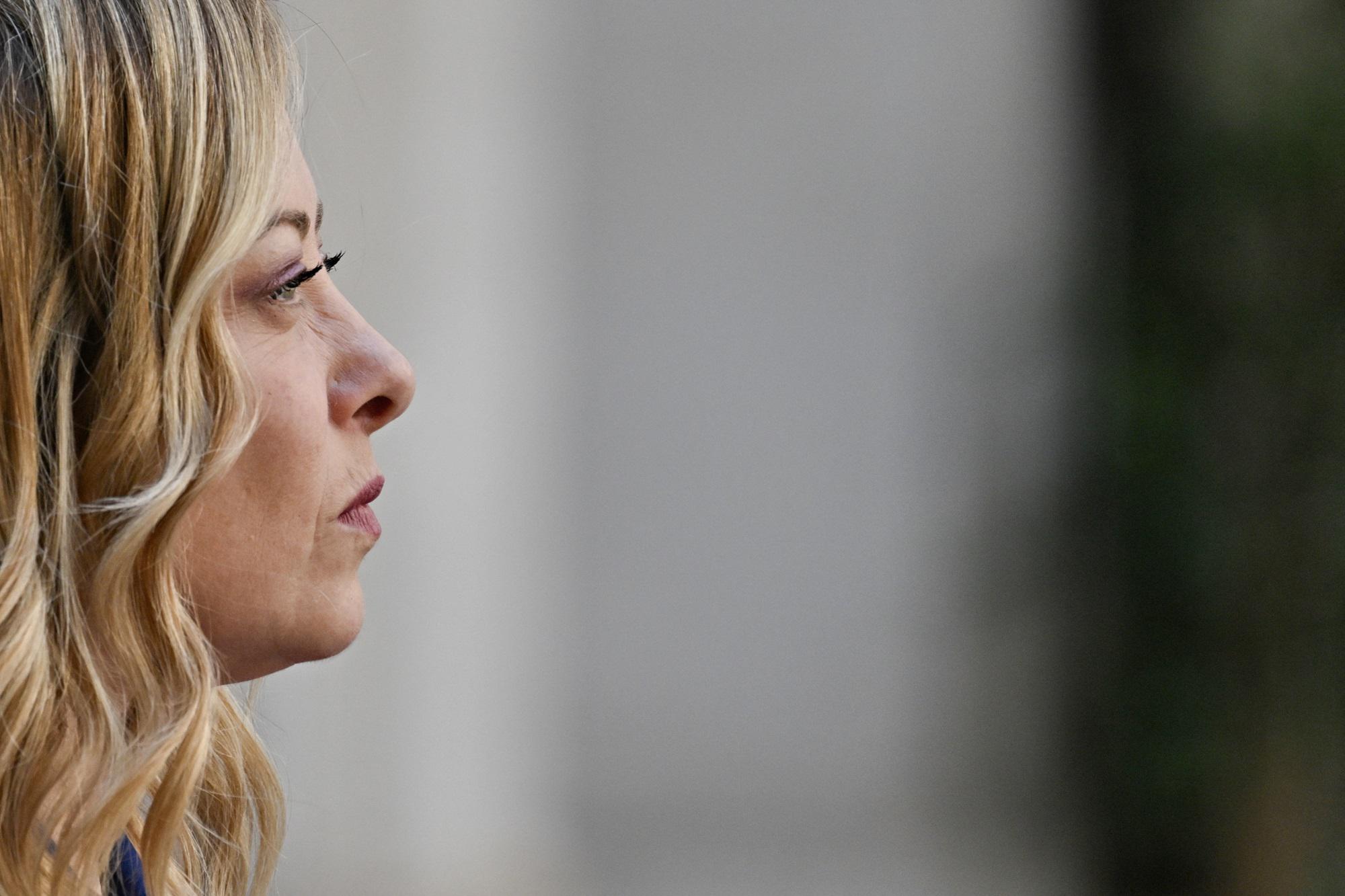
“I fear the Greeks, even when they bear gifts” (“Timeo Danaos et dona ferentes”). Laocoön tried in vain to stop the destruction of the city walls to admit that strange gift from the Greeks. Today it is Giorgia Meloni who embodies the Trojan horse being used to try to destroy Europe, reopening the wounds of the twentieth century’s civil wars and calling into question rights and protections won over the past 80 years. On 23 August, the New York Times presented her as the face of “a post-fascist Italy opening the door to power for the far right,” explicitly referring to the possibility that, after her, Marine Le Pen might win the 2027 presidential election.
The American newspaper enjoyed Meloni’s retort (“Italy and I never beg anyone”) when she hit back in kind at Trump, who had claimed “She begged me to take a selfie with me.” And yet Meloni keeps defending the idea of a united West. Once Trump’s term ends, she speaks of returning to the system of alliances that allowed the United States to dominate “the entire world.”
The paper did not fail, however, to ask the question : “Is she a fascist ?” and answered evasively : “It’s a particularly complicated story.” The NYT explained that “Giorgia” was born in 1977, well after fascism’s inglorious end, and that once in government she criticised “totalitarian and authoritarian” regimes as well as Mussolini’s “racial laws.” But it added that she has always remained attached to the thinking of the neo-fascist circles of the late twentieth century — like the one in Colle Oppio, the Rome neighbourhood where she settled at age 15. Those circles served as a refuge for a youth on the margins of society, who felt persecuted by left-wing culture: offended by the rulings of judges who were then beginning to sentence their elders — the fascists of the 1960s — to life imprisonment for murders and massacres, and besieged by the idea that the Republic had been born out of the Resistance and anti-fascism.
But it is precisely there, in that link to this more recent past, that Giorgia Meloni’s modern fascism lies. Her Judeo-Christian battle cry — “I am Giorgia, a woman, a mother, I am Italian, I am Catholic” — her willingness to legitimise Orbán while courting von der Leyen; her friendship with the “Francoist” Abascal, which pushed her to denounce the free-movement agreement with Spain, even though she knew perfectly well that no migrant could take a ferry to Europe from Ceuta. And it is out of this complicity with these young men that the pact struck with her party, Fratelli d’Italia (26% in the 2022 election), was born : “Politics for me, all the appointments for you.”
Italians are bearing the consequences. The old parties used to pick the people placed in ministries, cultural institutions, and administrative and oversight bodies from antechambers forever crowded with the ambitious and the opportunistic; today, the new power selects them from small, tenacious groups of neo-fascists, brimming with frustration and a thirst for revenge.
Two culture ministers, a tourism minister and a deputy justice secretary have all been swept away by grotesque episodes unworthy of a civilised country. An orchestra conductor was driven out after a relentless campaign against her. Italy’s public broadcaster, RAI, now counts among its executives people simply not up to the job. Justice Minister Carlo Nordio shielded from a European Criminal Court arrest warrant a torturer and killer of migrants, whom he flew back to Libya aboard a state aircraft.
Meloni gets photographed alongside Denmark’s social-democratic prime minister to say no to migrant landings; but she stays silent about the prison she had built in Albania to send asylum seekers back before they even set foot on Italian soil — a prison that sits empty because the government ignored the very laws magistrates are instead bound to enforce.
To each of the other two parties in her majority, Salvini’s League and Forza Italia, Meloni granted a deputy Prime minister’s post and two reforms: the first meant to let the northern regions stop supporting the south; the second meant to muzzle magistrates, at least those investigating politicians. One was struck down by the Constitutional Court, the other rejected by a large majority in a popular referendum.
What remains is Fratelli d’Italia, the nation’s black heart, a preview of what could happen across Europe. “They’re not even fascists anymore,” exclaims Franco Cardini, a prominent right-leaning historian. True enough. They hate the Resistance, they’re out for the blood of liberals and progressives, but they know little about the history of Fascism — about Galeazzo Ciano (fascist Italy’s former foreign minister and Mussolini’s son-in-law), executed for treason, or about the Grand Council that deposed Mussolini in 1943. They have never read Giovanni Gentile, the philosopher who nonetheless reformed the school system under Fascism, nor do they understand who Mosca and Pareto were, right-wing intellectuals from before the twenty years of Fascism. This party could well become the ideal instrument of a totalitarian power, should Meloni succeed in imposing the “fraudulent electoral law” proposed by the prime minister (a proportional system with no single-member constituencies and no preference votes, plus a majority bonus turning 42% of the vote into 54% of the seats).
And if Italy’s “Brothers and Sisters” ever felt threatened, they would flee the current henhouse for the most villainous ideology going. Putin’s hybrid war has gifted Italian politics a new player, Roberto Vannacci: a pro-Russian former general who wants to expel migrants down to the third generation, restore the patriarchy, and who glorifies the Decima MAS, a fascist-era naval combat unit from the Second World War. Meloni is now under threat from her right by Vannacci’s outrageous positions, and contradicts herself twice a day. Have you worked out yet whose side she’s on — the “volunteers,” Putin, or Trump?
Meanwhile, the warriors are getting ready to climb down from their horse and spread chaos through the streets and homes of Troy.