Maurizio Donini
The Current Situation: Permanent Occupation, “Borderisation”, and the EUMM Presence
In the wake of the ceasefire agreement negotiated on behalf of the EU by then French President Nicolas Sarkozy, Russia withdrew its invading troops from undisputed Georgian territory, but went on to unilaterally recognise the independence of Abkhazia and South Ossetia (26 August 2008). Moscow converted the former interposition forces into permanent Russian army military bases (the 4th and 7th military bases), deploying thousands of troops along with Federal Security Service (FSB) border guard units along the Administrative Boundary Lines (ABL). For this reason, Tbilisi’s legislation (the 2008 Law on Occupied Territories) and international law unambiguously classify both regions as Georgian territories under temporary occupation by the Russian Federation.
At the same time, Moscow dismantled the pre-existing multilateral presence through use of its veto power: in December 2008, it blocked the renewal of the OSCE mission, active since 1992, and in June 2009 it terminated the UN’s UNOMIG mission, bringing to an end nearly sixteen years of international observation in Abkhazia.
Although the Kremlin regards the two secessionist republics as sovereign allied states — having, for nearly two decades, declined the formal annexation requested in local referendums so as to keep them as levers of destabilisation against Tbilisi — international law leaves no room for doubt. As reaffirmed by UN General Assembly resolutions and the 2021 ECtHR Grand Chamber judgment (Georgia v. Russia II), Abkhazia and the Tskhinvali region are sovereign Georgian territories under Russian “effective control” and military occupation.
From a doctrinal standpoint, the two entities fall into the category of puppet states, lacking the conditions of effectiveness and original independence enshrined in the 1933 Montevideo Convention. Local decision-making autonomy is a mere legal fiction: their economic survival depends for more than 70% on direct transfers from the Russian federal budget, the rouble is their legal tender, defence is integrated into Moscow’s strategic apparatus, and the borders are patrolled by the FSB. The applicable case law follows the well-known precedent of the Turkish Republic of Northern Cyprus (Loizidou v. Turkey, ECtHR, 1996), in which the local entity is characterised as a subordinate administration lacking autonomous legal personality, with responsibility resting entirely with the occupying power.
Under the principle of ex injuria jus non oritur (no right arises from an unlawful act), the international community is bound by an absolute duty of non-recognition. This principle admits only one humanitarian mitigation: the Namibia exception, formulated by the International Court of Justice in its 1971 advisory opinion. In order to prevent the nullity of state acts from spilling over into the daily lives of resident civilians, international practice accepts the validity of essential civil-status acts (birth, marriage and death certificates), without this implying any recognition of the sovereignty of the de facto authority or the occupying power.
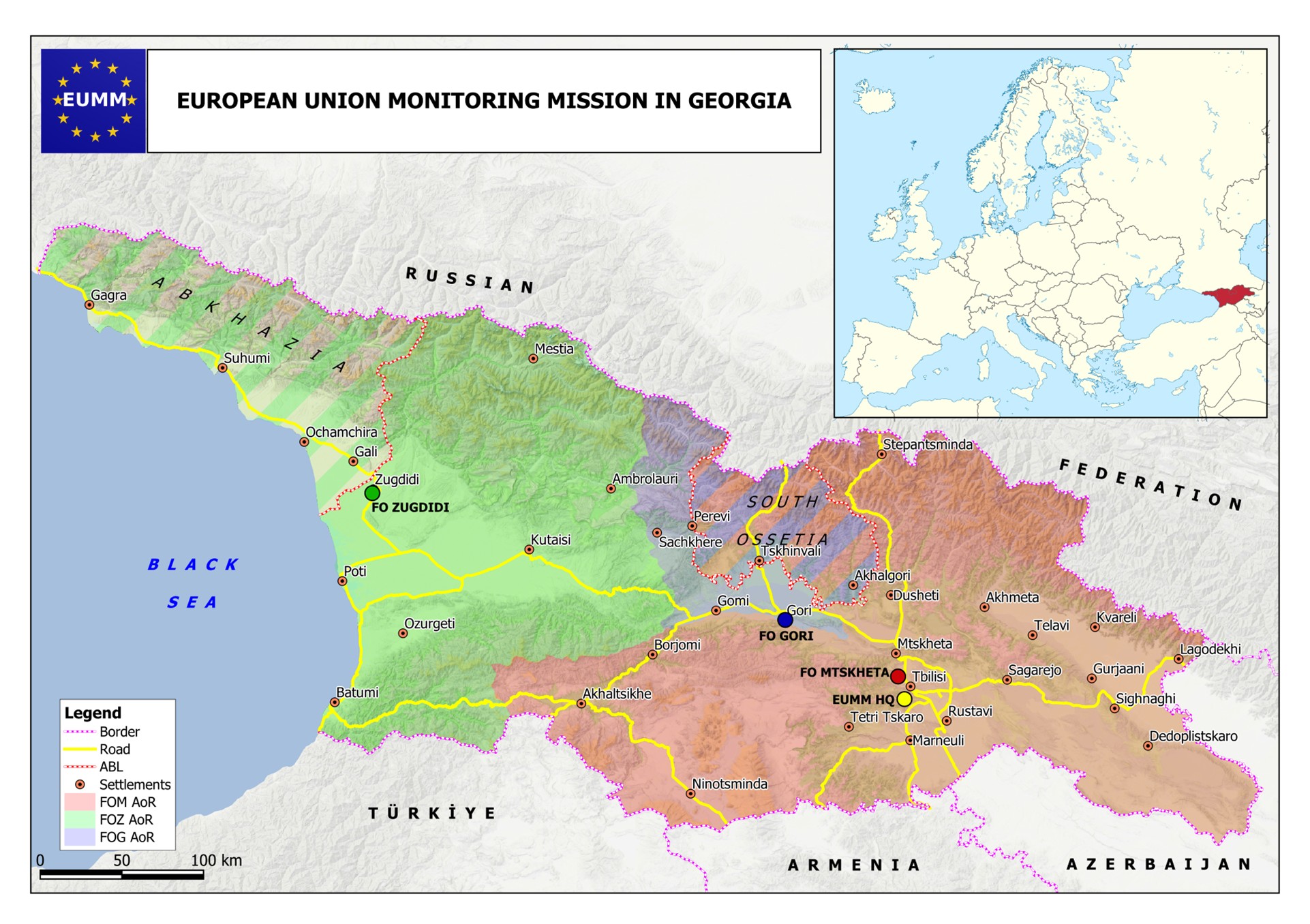
Following the vacuum left by the UN and the OSCE, the EUMM Georgia (European Union Monitoring Mission) civilian mission has remained the sole international monitoring presence on the ground, as well as the most heterogeneous CSDP crisis-management operation the European Union has ever run, with personnel seconded from 25 member states. The EUMM monitors, on a daily basis, a low-intensity latent conflict marked by what is known as “borderisation”: the unilateral advance of fences, barbed wire and earthworks by Russian forces, which fragments local communities, blocks access to farmland, schools and cemeteries, and imposes a regime of intermittently open crossing points.
The mission’s mandate reveals a deep divergence between its formal scope and its practical application. De jure, under Joint Action 2008/736/CFSP (and subsequent extensions pursuant to Articles 42(4) and 43(2) TEU), the mandate conferred by the EU Council and ratified by Tbilisi extends across the whole of internationally recognised Georgian territory, including Abkhazia and South Ossetia. De facto, however, an insurmountable obstacle persists: Russian forces and the separatist authorities disregard the 2008 agreements by refusing observers any physical access beyond the ABL. The EUMM is therefore forced to monitor the occupied areas from the outside, relying on long-range visual observation, satellite imagery and direct testimony from the population.
To govern the status of its unarmed observers, the European Union concluded a Status of Mission Agreement (SOMA) with the Tbilisi government, formalised on 3 December 2008 and ratified by the Georgian Parliament. The use of a SOMA — the instrument specific to civilian crisis-management missions — rather than a SOFA (Status of Forces Agreement, reserved for combatant armed forces) reflects the unarmed, impartial nature of the contingent. The agreement grants EUMM personnel a status modelled on Article 37 of the 1961 Vienna Convention on Diplomatic Relations: it provides full immunity from the host state’s criminal, civil and administrative jurisdiction for acts performed in the course of their official duties; the inviolability of premises and assets (thereby ensuring that the Tbilisi headquarters, the field offices in Gori, Mtskheta and Zugdidi, vehicles and radio equipment are protected against any search, requisition or seizure); and full freedom of movement across the entire national territory, without charge or prior authorisation, along with customs exemptions for mission equipment and a tax exemption on seconded personnel’s income.
Despite the strong technical credibility the EUMM has built up over nearly two decades of uninterrupted patrols, the current strategic context is marked by a stark asymmetry: while the EU mission continues to provide deterrence and stability along the demarcation lines, political relations between Brussels and Tbilisi are going through an unprecedented crisis. The adoption of the “foreign agents” legislation, the contested autumn 2024 election, and the unilateral decision by the Georgian Dream-led executive to freeze the EU accession process until 2028 all point to a scenario of deep institutional uncertainty. Against this backdrop, the periodic renewal of the EUMM’s mandate — subject to the unanimity rule within the EU Council — remains not only a test of European diplomatic cohesion, but also the last safeguard ensuring respect for international legality in the South Caucasus.
(Episode 3/The End)