Roberto Bertoni
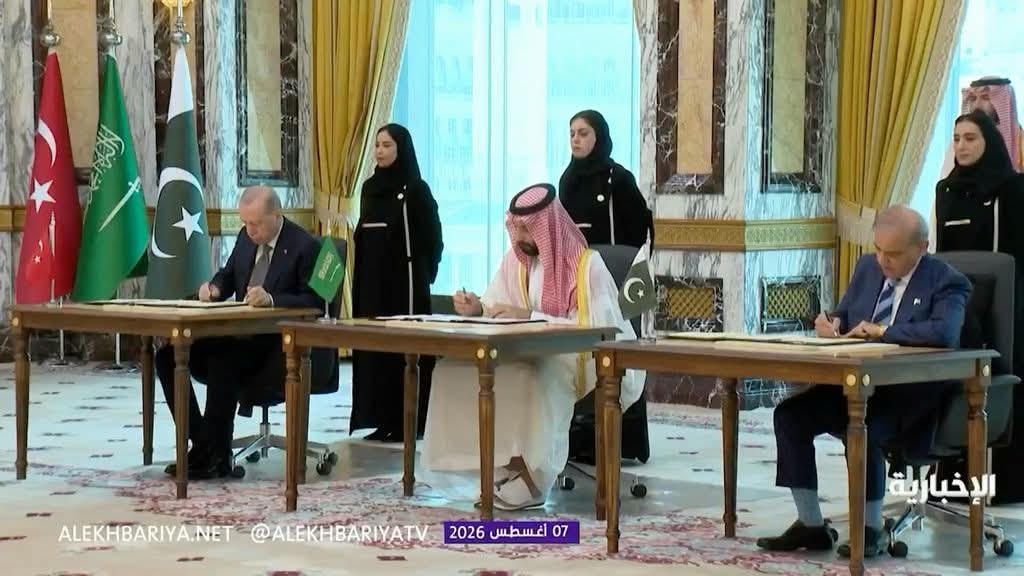
Amid the eventful summer that has just ended, one piece of news went curiously unnoticed, even though it may well be the geopolitical event of the year: the pact signed on 7 August at Mecca between Saudi Arabia, Turkey and Pakistan. The world’s foremost oil and religious power (the location chosen for the meeting was, of course, no accident), NATO’s second-largest military power, and a nuclear-armed state have joined forces, effectively declaring the end of American hegemony over defence and the settlement of international disputes. After all, Trumpism is nothing more than an isolationist doctrine that, over the course of the second term, has turned into a kind of traffic controller devoid of any strategy or, worse still, driven solely by the personal and financial interests of its dominus. What contemporary America lacks is thus not even the will to play a role in the world, but the capacity to do so — caught in a pincer between Bannon’s doctrine, inspired by America First and the paleoconservatism of the 1920s his mentor invokes; Vance’s moderate interventionism, the “hillbilly” turned vice president with plain presidential ambitions; and Rubio’s interventionism — the Cuban-American secretary of state who, of the three, sits closest to the old GOP doctrine of Reagan and the Bushes, now supplanted by the new MAGA line.
In practice, a party within the party has been born in the United States and has ended up taking the upper hand over the Republicans, and there will be no going back, especially given that all the previous balances of power have vanished: the bilateral one that held until 1989, ending with the fall of the Berlin Wall and the dissolution of the Soviet Union, and the unilateral one of the post-1989 period, which entered into crisis in 2001, when liberal, capitalist globalisation began showing clear signs of running out of steam — worsened by the tragedy of September 11 — before collapsing for good with the failure of Lehman Brothers in September 2008. What followed was an interregnum of some fifteen years, during which the Obama and Biden presidencies led the Democratic world and Europe’s left to believe it was still possible to follow the path of the Third Way and the “gentle Western breeze,” before having to reckon, in the meantime, with Trump’s first presidency, Brexit in Britain, and the rise of sovereigntist movements across the Old Continent. The wars in Ukraine and the Middle East are thus nothing more than the projection of those fifteen years of absence: an interlude during which, to borrow from Gramsci, between what is no longer and what is not yet, the monsters we now see at work almost everywhere made their appearance.
Returning to the question of this new Gulf NATO, it is not, strictly speaking, a military agreement, but rather a geopolitical understanding resting on extremely powerful foundations, reinforced by the religious element — a theme our secularised West tends to underestimate, even though it carries crucial weight in the Middle East and in buffer states like Turkey, caught between these two worlds.
Saudi Arabia, Turkey and Pakistan: hardly a triumph of democracy, but then again, if a new Yalta were to take place today, Europe would be watching from the sidelines — assuming, that is, one is willing to count as European the Britain of Churchill who, in 1945, sat at the table of the Great Powers to redraw the rules of the planet’s coexistence. If something similar were to happen today, in short, it would not be out of the question for it to take place in Dubai or, perhaps, once again in Saudi Arabia, under the aegis of bin Salman, the multibillionaire prince who has bought himself the 2034 World Cup and is planning futuristic stadiums, cities rising out of the desert, and technological and urban development comparable to what occurred in our own latitudes after the war. A pity that Europe today is bereft of statesmen and is thus destined, we fear, to fall apart — all the more so should figures like Le Pen or Bardella in France, the semi-Nazis of the AfD in Germany, the neo-Francoists of VOX in Spain, and other such “monsters,” to quote Gramsci again, come to power; their sole aim being a return to petty homelands and a cut-rate ethno-nationalism, doomed to sink under the blows of the real powers.
As for America, let us say it again: either the miracle of an Ocasio presidency comes to pass, in which case it could still play a role in the world, under the banner of a Rooseveltian-style New Deal and a revival of the principles and values that once inspired us to leave behind the horrors of Nazi-fascism, or it will end up turning into a peripheral power — as arrogant as it is incapable of getting a grip on events, and therefore irresolute and, as a result, extremely dangerous, given that it is impossible to convince a people raised on “Manifest Destiny,” in an almost messianic vision (not unlike what the mirage of the Promised Land represents for Jews), to accept being downgraded. An Ocasio-Cortez presidency, we said, might offer a polycentric horizon, with America still a leading player but no longer Number One; but how many of her compatriots would be ready to take such a step? How much of public opinion would follow her down that road — a road Obama travelled, in his own way, between 2008 and 2016, for instance through his policies of détente toward the Middle East and Cuba, but one entirely abandoned by Trump, already scaled back by Biden himself, and never truly pursued by the defeated Democratic candidates, Clinton and Harris?
These are the premises that gave rise to the aforementioned Gulf Pact, and these are the foundations of a new world order capable of reversing, one hundred and ten years on, the carve-up of the old Ottoman Empire decided at a table by Sykes and Picot — that is, by Britain and France — on 23 May 1916. If you think about it, and geopolitical purists will forgive us for saying so, bin Salman, Erdoğan and Sharif have achieved, on a grand scale, what Caliph al-Baghdadi once tried to impose through ISIS’s barbarism. This is a delicate point, granted, and we would never allow ourselves to compare three political leaders of this stature to a terrorist organisation, but in an age when everyone wants to make their nation great again, the three men in question have done nothing more than that, sealing their pact in the most emblematic setting in the Muslim world.
Trump, caught up in his own ego and midway through a presidency that seems to have slipped from his grasp, does not appear to have grasped the historic significance of what has happened; nor has the European Union. Be that as it may, the Euro-Atlantic world that has set the tone since 1949 will now have to reckon with a new reality that, added to the BRICS, tells us that polycentrism and a respectful understanding with once-unthinkable actors are the only way to avoid new conflicts. And this holds true, it must be said, for Putin, Xi Jinping and Kim Jong-un as well — we may like them or not, but they head three nuclear powers on whom Asia’s fate depends. Not to mention Africa’s unstoppable demographic growth, which confronts us with the challenge of integration and coexistence within an ever more multicultural, multi-ethnic society.
The macho, male world of Yalta, the Iron Curtain, the rival blocs and their respective furies have, by contrast, had their day. This is also why we believe it is time to make NATO into something different: a cultural and diplomatic, geopolitical and geostrategic alliance first, and only then a military one — capable of cooperating with the rest of humanity, which is no longer willing to endure a de facto colonisation.