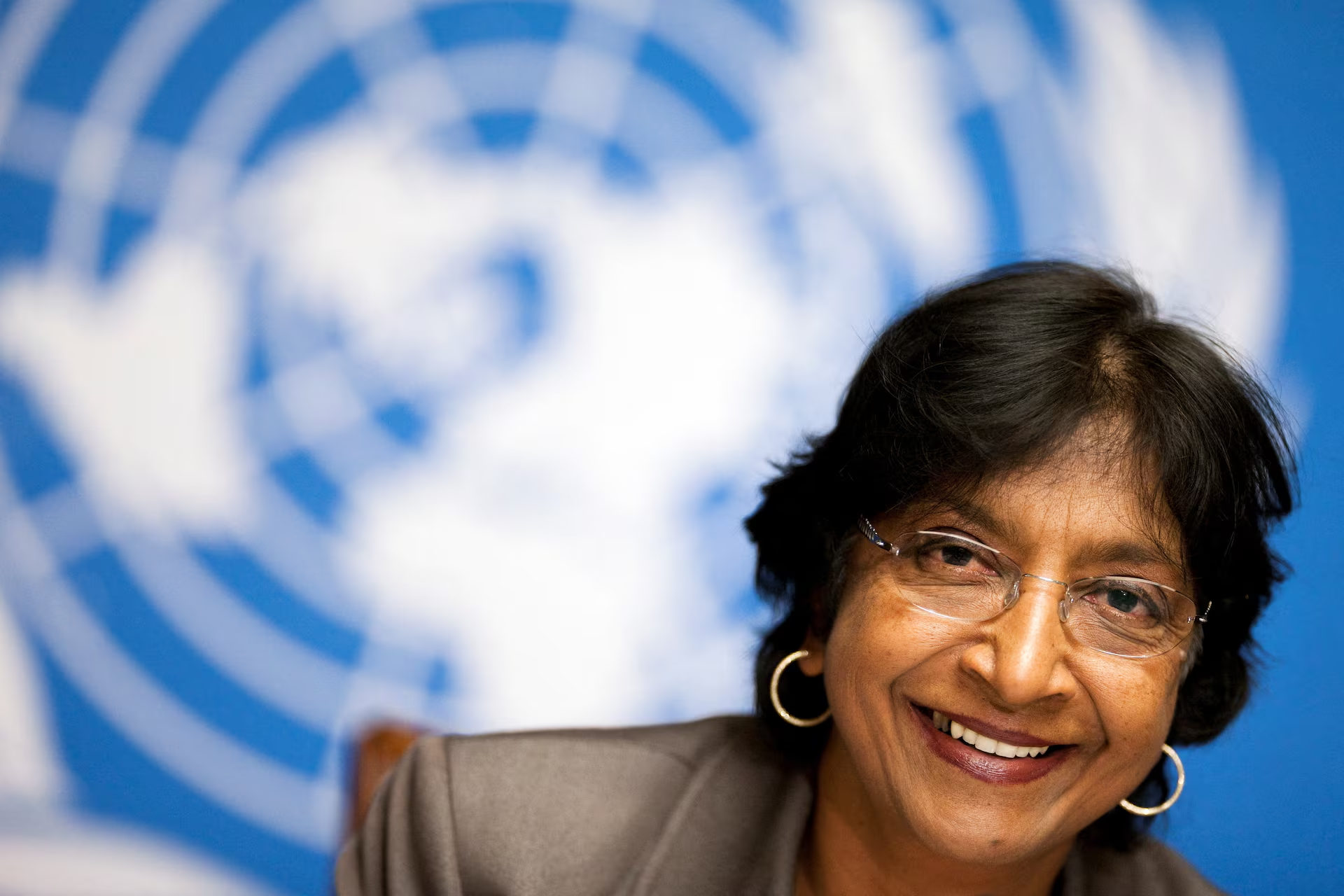
Chloé Maurel
The choice of a South African lawyer with a long-standing commitment to international law
On 9 October 2026, in Oslo, the Norwegian Nobel Committee awarded the Nobel Peace Prize to Navanethem “Navi” Pillay, an 85-year-old South African jurist, for her commitment to peace and international law. Committee chair Jørgen Watne Frydnes praised a career devoted to holding states and their leaders to account for their actions and to restoring hope to victims of violence and conflict. The committee highlights in particular her contribution to consolidating an international legal order capable of prosecuting war crimes, crimes against humanity and genocide.
This distinction goes well beyond honouring an individual career. It raises a central question of political science: how can peace be built when military power balances, national interests and the might of the great powers tend to prevail over common rules? In honouring Navi Pillay, the committee reminds us that peace is neither the mere temporary halt of fighting nor the conclusion of agreements between leaders. It also requires justice, recognition of victims, and mechanisms capable of punishing those responsible for crimes. The Nobel Committee thus underscores the principles of international law championed by the UN.
Moreover, awarding the prize to a woman — and a Black woman from an African country at that — deserves to be welcomed. For a long time, the prize went essentially to Europeans and North Americans.
Navi Pillay: a jurist born under apartheid, and a figure of international justice
Born on 23 September 1941 in Durban, into a South African family of Indian Tamil descent, Navi Pillay grew up under the apartheid regime, institutionalised from 1948. Racial segregation then governed access to housing, education, employment and political representation. Coming from a community subject to multiple forms of discrimination, she pursued legal studies and became a lawyer.
In 1967, she opened the first law firm headed by a woman in the province of Natal. She also became the first Black woman to sit on South Africa’s High Court. In the course of her practice, she defended opponents of apartheid, at a time when political activists, resistance organisations and their supporters were exposed to repression. She committed herself both to opening up male-dominated legal professions to women and to defending rights against a racist, segregationist state.
South Africa’s democratic transition, launched in the early 1990s and sealed by the multiracial elections of 1994, opened a new chapter. In May 1995, Navi Pillay became a judge at the International Criminal Tribunal for Rwanda (ICTR), created by the UN Security Council in November 1994 after the genocide of the Tutsi, which claimed around 800,000 lives. Through the case law she helped establish, she contributed to the recognition of rape as a possible instrument of collective destruction in wartime.
Pillay then presided over the ICTR from 1999 to 2003. She joined the International Criminal Court (ICC) in The Hague in 2003, before being appointed UN High Commissioner for Human Rights in 2008, a post she held until 2014. In that role, she defended the universality of human rights, including when protecting them meant holding powerful governments to account.
Finally, in September 2025, Navi Pillay, as head of the UN’s Independent International Commission of Inquiry on the Occupied Palestinian Territory, presented a landmark report concluding that Israel was committing genocide in the Gaza Strip. The report identified four of the five constitutive acts of the crime as defined by the 1948 Convention, as well as a specific intent to destroy the Palestinians of Gaza.
Her path thus lends the 2026 award a particular coherence: from the struggle against apartheid to international tribunals, justice emerges, through this prize, as a condition of lasting peace, in keeping with the principles of the UN.