The UN is now over 80 years old, and it shows. Brought into being by the 51 states convened in San Francisco by the true victor of the war, the UN spent its early childhood nurtured by bright hopes and high expectations. Thanks to Eleanor Roosevelt’s activism, the Universal Declaration of Human Rights was even adopted on December 10, 1948. No one dared to vote against it: the Soviet bloc, Saudi Arabia, and South Africa limited themselves to abstaining. Every December 10, the anniversary of the Declaration continues to be celebrated, even though its lofty principles are trampled on every day.
Before long, the UN was also mourning its dead: in 1961, its own Secretary-General, Dag Hammarskjöld; in 2003, Sergio Vieira de Mello, the Special Representative for Iraq; and at least 4,200 peacekeepers who fell in the name of a peace that has too often been elusive.
Every September, the 193 members of the United Nations gather at the Glass Palace. The smallest countries hope to be heard by the largest ones at least once a year. It is striking to witness the renewed cries for help from tiny island states threatened with disappearing because of “global warming.”
In response, the president of the United States scolded them: “You should not call it ‘global warming’; at most, you can talk about ‘climate change,’ a natural phenomenon that has always existed.” In any case, he argued, it is a hoax—a scam targeting those who create wealth by extracting gas and oil.
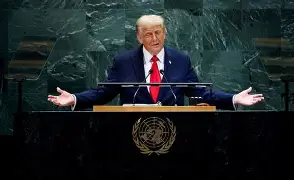
“That is why,” he explained from the podium of the UN General Assembly, “we had to intervene to prevent the International Maritime Organization from secretly introducing a global carbon tax, which would have increased maritime shipping costs by 10 to 20 percent.”
A secret tax?! But he went on: “There is no global government, and as long as I am president, there will be no global taxes.”
Of all the legacies he leaves behind, environmental denialism will be remembered as the most damaging to humanity. Future generations will subject him to a form of damnatio memoriae—condemnation to oblivion.
From the podium, Trump also spared no criticism for the very institution hosting him: “This year, we cut the UN budget by 15 percent, eliminating more than 4,000 positions in that bureaucracy. The United Nations has enormous potential, but it must stop imposing the far-left agenda set by globalist bureaucrats who have never been elected by anyone.”
The far left? People elected by no one? Perhaps he was referring to aid workers striving to eradicate endemic diseases in Africa, Asia, and Latin America. They, above all, have borne the brunt of Washington’s funding cuts: not only those affecting the WHO in Geneva and the UN Environment Programme (UNEP) in Nairobi, but also the billions of dollars allocated to USAID, the development agency established by John F. Kennedy, which presented the world with the more compassionate and admirable face of the United States.
Now, because of the suspension of health programs, the most vulnerable countries are recording millions of additional deaths: in Congo alone, more than 4,000 people have died from Ebola since last May. Mary Trump, the tycoon’s niece, puts it well: “Empathy is not one of my uncle’s virtues.”
On the same occasion, Trump also issued a threatening appeal: “I urge all member states of the International Criminal Court to withdraw immediately from that outlaw institution.” He then explained why: “We will never allow our military personnel to be investigated or subjected to show trials by an anti-American court that has no jurisdiction over us. These are evil people.”
So the Rome Statute, signed by 125 countries around the world, is outlawed, and the Court’s judges are evil?
He then tried to reassure the General Assembly on a crucial issue: “While others talked, I acted. While others discussed peace, I brought peace. Since taking office, I have had the great honor of ending eight conflicts.”
But he also posed a terrifying question to the entire world: “I am now faced with an important decision. Should I reach an agreement with Iran that allows it to become a greater country than it was before? Or should I annihilate the Islamic Republic? If that is the choice, I will do it quickly.”
With matters standing as they are, we must conclude that the conflict with Iran was not among the eight conflicts he claims to have settled. Nor will we ever know what the other conflicts were.
In his address, which ran well over the time allotted by the UN organizers, Trump naturally mentioned Venezuela and Cuba.
“In January, on my orders, our military carried out a massive operation in the heart of Caracas, arresting the outlaw dictator Maduro.”
It apparently never occurred to him that abducting a foreign head of state—or killing another in Iran—might itself constitute an unlawful act. Quite the contrary.
“Last month, we signed the largest oil deal in history, involving 65 billion barrels of oil. The world’s leading oil companies are coming in. If you combine the United States and Venezuela, we have more than 60 percent of the world’s oil. We will no longer tolerate threats against America, and, if necessary, we will use our unparalleled military power to protect our vital interests.”
It was unclear what threats he was referring to, unless he meant those supposedly fueled by Cuba. He therefore reassured his audience: “We are seeking radical change in Cuba. It is a failed state. For decades, the regime has coordinated with the radical left and communist networks here. It has cultivated ties with subversive and radical groups such as the Communist Party USA, Antifa, and the Democratic Socialists of America. But communism will never come to America.”
Having reassured his audience, he did not fail to sing the praises of his own achievements, even though they have yet to be confirmed at the November 3 elections:
“America is back. Our economy is the envy of the world. Our energy powers the planet. Our future is bright. Real household incomes have risen to record highs, reaching an average of $87,000. We have worked to eliminate every unnecessary regulation and every obstacle to business activity. We have enacted the largest tax cuts in American history. When I arrived, Washington was plagued by crime; today, the crime rate has fallen by 87 percent. Just look around: tourism is booming. Restaurants are bustling.”
Hold on, Mr. President. You are stealing the lines of our very own Berlusconi, who told us on November 4, 2011: “Life in Italy is that of a prosperous country; consumption has not declined. It is difficult to book a seat on a plane. Restaurants are full.”
First published by the Center for State Reform (October 9, 2026).