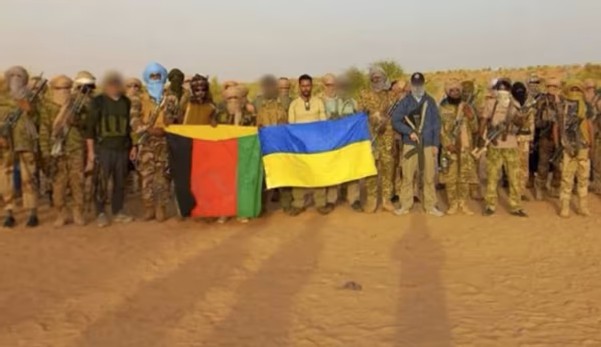
Ukraine’s military involvement in African crises is not limited to the Sahel. Nearly 1,000 Ukrainian commandos, mainly from the HUR’s “Timur” unit, are reported to have been deployed to Sudan at the request of Sudanese leader Abdel Fattah al-Burhan. Operations against the Rapid Support Forces (RSF), linked to Russia’s Wagner network, reportedly include night raids, reconnaissance activities, FPV drone strikes, sabotage of supply lines, interrogation of captured Russian personnel, and training Sudanese forces in drone use.
Here too, Ukrainian involvement can be read as a transfer to Africa of operational methods developed during the war against Russia. Ukrainian special forces are said to have introduced reconnaissance and sabotage techniques, as well as drone employment methods honed on the European battlefield, adapting them to the characteristics of an urban, asymmetric conflict like the one unfolding in Sudan.
Another element, not directly documented but theoretically plausible, concerns the possible transfer of AI-based technologies from Ukraine to African governments and insurgents. Reuters has reported that AI systems developed in Ukraine allow drones to reach their targets autonomously, without needing continuous guidance from an operator. This capability is particularly significant in an electronic-warfare environment, since interruption or jamming of the radio link with the pilot would not necessarily prevent the drone from completing its mission.
Ukraine’s technological development, however, goes beyond the mere use of AI-based assistance systems. The Center for Strategic and International Studies (CSIS) has described progress in several areas, notably autonomous navigation, computer vision, target recognition, the integration of intelligence data into mission planning and execution, and the ability to operate in environments where the GPS signal is unavailable or disrupted. As early as 2024, Ukraine had dozens of AI systems in use to help drones identify and strike their targets. One Ukrainian manufacturer has also stated that it sold more than 15,000 units of automated targeting software to drone makers.
The implications of this technological shift could be particularly significant in the Sahel. Terrorist groups such as JNIM already use drones: according to ACLED, more than 89 incidents linked to their use were recorded between 2023 and 2025, 69 of them classified as attacks. At a more advanced level, AI could reduce drone operations’ dependence on the availability of highly specialised operators. Growing system autonomy could allow armed groups to rely on less experienced personnel, potentially lowering the skill level required to conduct drone operations and, with it, the cost and time devoted to operator training.
Strategic analysis
The African continent occupies a growing place in the geopolitical competition tied to the Russo-Ukrainian war. Kyiv and Moscow have gradually strengthened their diplomatic presence and, in some cases, their military engagement in regions marked by high political and security instability, notably the Sahel. A fundamental strategic question therefore arises: why devote considerable resources to operations and initiatives outside the main theatre of war, when the conflict in Ukraine remains extremely costly in economic, military and logistical terms?
For Russia, its power projection in Africa, now largely integrated into state structures, also serves an economic function, potentially helping to generate revenue and acquire resources that can support Moscow’s war effort. The Russian model of military and commercial presence rests on providing security services in exchange for payments, economic concessions or access to natural resources. This model gained importance after Prigozhin’s death in August 2023, following which the Wagner Group was gradually transformed into the Africa Corps, a state structure responsible for security activities and commercial projection abroad.
In June 2025, for example, Russia and Mali signed agreements on geological exploration and natural resource development. Reuters also reported the start of construction on a Russian-backed gold refinery in Mali. With around 3,500 personnel in the country, the Malian government is said to pay Russia some $35 million a month, or roughly $420 million a year.
The Central African Republic is another significant case for understanding the “resources for security” model. As Central African officials have pointed out, Russia is reportedly seeking to gradually shift its commercial model from one based mainly on access to natural resources to one based on direct payments. The Central African authorities are said to have replied that they could not bear such financial outlays and to have proposed compensating Russia with resources such as gold, uranium and iron. A 2026 investigation by the Global Initiative Against Transnational Organized Crime estimated that Russia’s Africa Corps was among the main beneficiaries of illegally sourced gold from the Central African Republic, to an estimated value of around $180 million a year.
Ukraine, by contrast, has developed its African strategy chiefly by strengthening its diplomatic presence. Kyiv has opened new embassies in Ghana, Rwanda, Mozambique, Botswana and Mauritania, with the stated aim of “countering Russian influence around the world.” In December 2023, Ukraine also adopted its first strategy specifically dedicated to communication with Africa, aimed at countering Russian narratives and refuting what Foreign Minister Dmytro Kuleba explicitly called “Russian propaganda.”
Among the tools Kyiv has used to project influence, the food sector has played a particularly important role. Through the “Grain from Ukraine” programme, more than 170,000 tonnes of grain had been shipped by March 2024 to countries such as Ethiopia, Somalia, Niger, Kenya and Sudan. Russia has the capacity to limit Ukrainian food exports and, in turn, to present itself as an alternative supplier on international markets. Ukraine has nonetheless shown that it can retain its role as a major global agricultural supplier. This capacity carries strategic importance for Kyiv’s economic resilience, particularly in a conflict that consumes vast resources and is waged against an adversary with greater economic and material power.
The question of resources is thus central to understanding both actors’ projection in Africa. The war between Russia and Ukraine has gradually turned into a war of attrition in which the availability of economic, energy, food and military resources is a decisive factor.
For 2026, Ukraine estimates its total war-related spending at around $155 billion. Kyiv also says it faces a funding gap of roughly $27 billion in order to sustain military operations until early 2027. This is especially significant at a time when military resources allocated by NATO have declined and European aid has gradually concentrated in the hands of a relatively small number of countries.
Russia, for its part, is undergoing a process of reallocating resources and must balance rising military spending against social investment and the need to keep inflation under control.
“An army marches on its stomach”: the famous maxim attributed to Napoleon sums up the importance of logistics and supply in sustaining any military effort. African governments hold significant natural resources and, at the same time, need security services to maintain control over their most unstable regions, as well as foodstuffs capable of meeting the needs of large and growing populations.
In this context, Kyiv and Moscow compete not only for access to resources but also for diplomatic influence, military presence and control over strategic narratives. The African continent, and the Sahel in particular, thus constitutes an increasingly important theatre of indirect competition between Russia and Ukraine. While that competition remains peripheral to the main European front, it increasingly helps determine both countries’ ability to project power, forge partnerships and consolidate their influence globally.