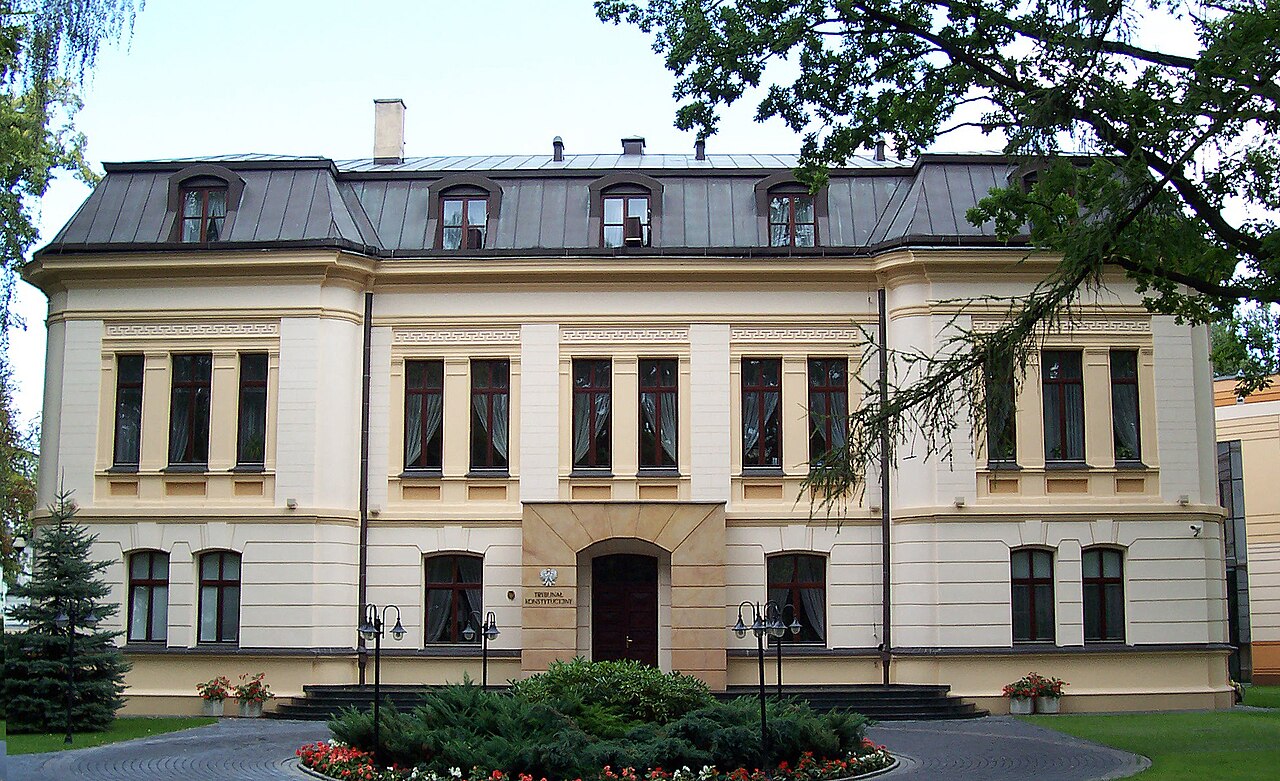
A constitutional crisis beyond political change
The crisis originated in 2015, when the Law and Justice party (PiS) began restructuring Poland’s judiciary, starting with the Constitutional Tribunal. Controversial judicial appointments and subsequent legislative changes progressively undermined the Tribunal’s independence and credibility. These irregularities were subsequently addressed by European courts, including the European Court of Human Rights and the Court of Justice of the European Union.
The Constitutional Tribunal plays a crucial role in Poland’s constitutional system. Comparable to France’s Conseil constitutionnel or Italy’s Corte costituzionale, it reviews legislation for compliance with the Constitution, protects fundamental rights and safeguards the separation of powers. Its purpose is to ensure that political authority remains subject to constitutional limits, regardless of which party holds power.
The parliamentary elections of 2023 brought a pro-European coalition led by Donald Tusk to government, raising expectations that Poland could reverse years of democratic backsliding. Yet electoral change proved insufficient to restore institutional independence. The new government inherited disputed judicial appointments, deeply entrenched institutional arrangements and a President capable of blocking legislative reforms. Therefore, Poland has pursued a strategy of partial restoration through administrative measures and accountability mechanisms, without being able to achieve comprehensive institutional reconstruction.
The latest confrontation: from institutional paralysis to open conflict
For several years, the Constitutional Tribunal had become increasingly dysfunctional. Its composition and legitimacy were contested, the government questioned the validity of judgments delivered by improperly constituted panels, and disputes over the publication and legal effects of its rulings further weakened its authority. The situation deteriorated as judicial vacancies remained unfilled or newly elected judges were prevented from assuming their duties. The result was a profound loss of the Tribunal’s capacity to perform its constitutional role. Citizens were deprived of an effective mechanism for challenging unconstitutional legislation, while courts and public authorities faced growing uncertainty about the applicable law. Above all, Poland was left without an effective and independent constitutional watchdog capable of checking legislative overreach and ensuring that public authorities remained within constitutional limits.
The immediate dispute concerns judges elected to the Constitutional Tribunal by the current parliamentary majority. Under the Polish Constitution, Constitutional Tribunal judges are elected by Parliament for nine-year terms. However, President Nawrocki refused to receive the oaths of some of them, while the Tribunal’s existing leadership, headed by Bogdan Święczkowski, prevented them from exercising judicial functions.
The conflict escalated on 30 October 2026, when Judge Anna Korwin-Piotrowska announced a temporary, one-month suspension of Tribunal President Bogdan Święczkowski and Vice-President Bartłomiej Sochański from their official duties. The measure was presented as necessary to overcome institutional obstruction and restore the Tribunal’s functioning.
Its legality, however, is disputed. The judge relied on the corresponding application of statutory provisions governing judicial duties in ordinary courts. The central doctrinal controversy is whether such provisions can legitimately be extended to the Constitutional Tribunal and whether they authorise the particular intervention undertaken. The distinction is fundamental because, in the legal system, the need to restore constitutional legality does not automatically establish the legal competence to employ any available corrective measure.
The Tribunal’s existing leadership rejected the decision, while President Nawrocki denounced the developments as an unlawful attempt to take control of a constitutional institution. The government, by contrast, defended efforts to overcome the paralysis and restore the Tribunal’s ability to function.
The confrontation has also triggered an intense political and information battle. Opposition politicians and representatives of the Tribunal’s disputed leadership have accused the government and those involved in the intervention of attempting a coup d’état, while dramatic scenes outside the Tribunal, police involvement and the President’s unexpected return from an overseas visit have amplified the sense of national emergency. These developments have been accompanied by a considerable volume of misleading and highly polarised political messaging, in which contested legal interpretations are frequently presented as established facts and accusations of criminal conduct. The result is an increasingly distorted public debate, as well as conflicting media coverage.
Possible scenarios and European implications
The challenges of restoration of the rule of law exemplified by the Polish Constitutional Tribunal illustrate a structural problem extending beyond Poland. As can be seen in other countries, institutional safeguards designed to protect judicial independence may, under conditions of institutional capture, be invoked to preserve arrangements that undermine that independence.
In the Polish case, several outcomes remain possible. The temporary leadership arrangements could be maintained and subjected to disciplinary or judicial scrutiny, potentially allowing the Tribunal to resume its functions. Alternatively, competing claims to institutional authority could prolong the crisis and further undermine legal certainty. A more durable solution would require political agreement and legislative reform, although cooperation between the President and parliamentary majority currently appears extremely difficult.
The crisis is unfolding in an environment of profound political polarisation, in which both sides increasingly regard concessions as unacceptable and institutional compromise as a sign of weakness. The President and the opposition present themselves as defenders of constitutional continuity, while the governing coalition sees decisive intervention as necessary to overcome years of obstruction. Competing institutions reject each other’s legitimacy, and political actors lack the willingness to negotiate.
There is a danger that, in the absence of political compromise and a shared commitment to constitutional principles, Poland may find itself trapped in a permanent cycle of institutional confrontation, where attempts to restore the rule of law generate new disputes over legality, while the original violations remain unresolved. Yet the current confrontation may also prove to be a turning point, creating an opportunity to break the institutional deadlock and restore effective constitutional oversight, although such an outcome would come with considerable legal and political risks.