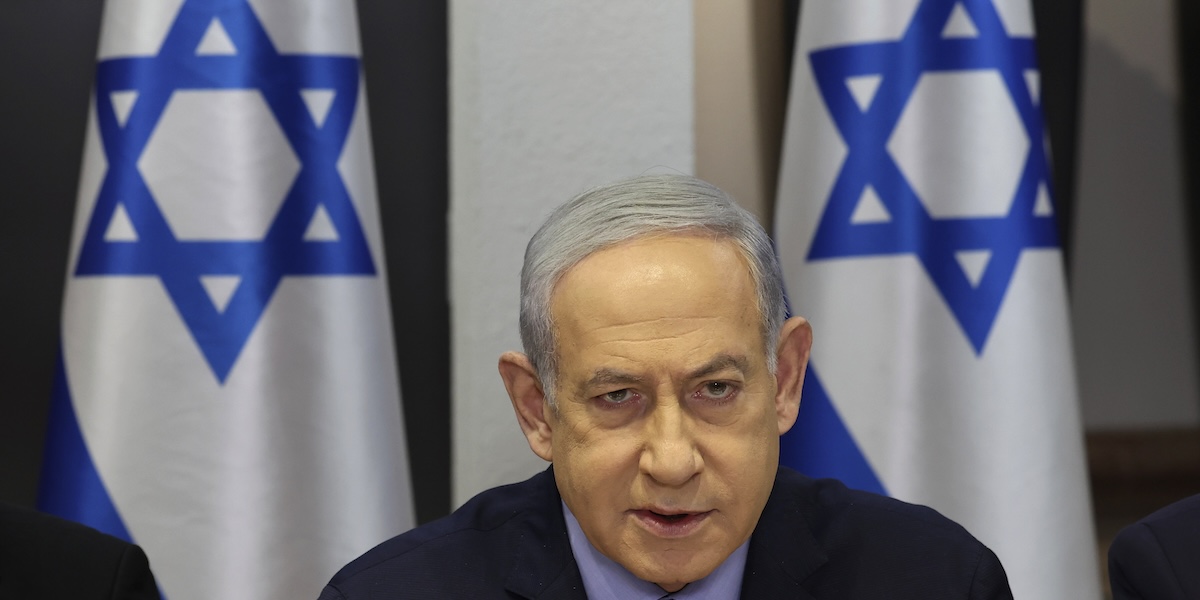
Over his four years of “rule,” Benjamin Netanyahu and his allies have worked relentlessly to undermine and demolish Israeli democracy, injecting a deadly poison into every part of it.
They have systematically sought to weaken the judiciary and the legislature, and have tried to turn the police, the intelligence services and the army to their own ends. They are now trying to finish the job by delegitimising the election result and paving the way for a constitutional conflict amounting to a veritable coup d’état — one already organised and planned several months before the elections, which included, besides non-recognition of the result, a number of time bombs in the form of laws due to take effect next January.
These are reforms designed to bring the broadcast media, the judges and the police’s investigative unit under government control, and to weaken the powers of the government’s legal adviser. For the opposition, which emerged from the latest elections victorious but divided, the political challenge is immense, perhaps difficult, but vital to the democratic future of the Jewish state. An antidote to the poison must be found quickly to save the patient. The four leaders of the bloc for change are aware of this urgency, all the more so as Netanyahu is not wasting any time.
After sowing terror on the eve of the elections by predicting a catastrophic future for Israel, with nuclear bombs and heavy international sanctions, the prime minister is now leaning on David Zini, head of the Shin Bet (Israel’s domestic intelligence service), a messianic fundamentalist whom he himself appointed in order to bring the leaders of the Arab opposition parties to trial. Zini holds the institutions in contempt, seeing them as an obstacle to the divine plan for a Greater Israel that is exclusively Jewish, and it is precisely for this reason that he tried to arrogate to himself the role of “grand inquisitor,” involving neither the police nor the government’s legal adviser in his investigations. “The Arabs stole the election” was Netanyahu’s slogan from the outset, echoed by his henchmen in the media: on Channel 14, but also on Channels 11, 12 and 13, journalists sympathetic to this thesis gave it ample airtime.
As expected, Likud supporters had spent the entire election day searching for evidence of fraud and irregularities at Arab polling stations in order to pass it on to the Shin Bet. What they gathered proved so insignificant that the chair of the Central Elections Committee, Noam Sohlberg, himself had to declare that the elections had been conducted in complete regularity. At his side were the government’s legal adviser, Gali Baharav-Miara, and the head of the Shin Bet himself, David Zini.
The alleged case of a rigged Arab vote was played up on television on public Channel 11 by Ayala Hason, a far-right journalist, in an investigation in which anonymous interviewees described episodes of electoral corruption. Among the most absurd testimonies was that of an anonymous polling station official who claimed to have been offered money to vote for an Arab party. For months, polls had credited the Arab lists with an unrealistic number of seats, between 10 and 14, when it was obvious they would win far more. The reasons were easy to grasp: the formation of a joint Arab list that avoided vote splitting, the adherence of Yoav Segalovich, a former MK from the centrist Yesh Atid party, Mansour Abbas’s Ra’am party, and the extraordinary “campaign for the Arab vote” run by Itamar Ben Gvir with his racist, intimidating politics. And so, in the end, the figure of 19 MKs was easily portrayed as suspect. The delegitimisation of the Arab vote will continue through street demonstrations (perhaps even an assault on the Knesset, Capitol-style?) and Israel’s institutions will be put to a severe test.
Netanyahu’s aim is to frighten the country and to confront the institutions and political forces with an ultimatum of the “After me, the deluge” kind, meaning either a national unity government that he would lead, or new elections in the spring. For his part, he has plenty of television journalists who, while striving to appear impartial, are in fact helping to spread the prime minister’s anti-democratic poison.
Despite all of Netanyahu’s attempts at sabotage, the elections passed calmly, without incident. The electoral process never suffered a malfunction, and Israeli democracy has overcome its most difficult test. Seeing veiled Arab women go to the polls for the first time in their lives was an extraordinary event, not only for Israel but for the entire Middle East. The mobilisation of the forces for change was exceptional, as also shown by the more than 70,000 Israelis who returned to the country to vote.
The disappointment that followed the vote was only partly justified. In any other country in the world, a score of 56% for the opposition against 44% for the government would have been considered a resounding success, commented Uri Misgav, a journalist at Haaretz. In Hungary, Serbia and Brazil, oppositions have won with a smaller margin. The hand extended by Arab citizens, exasperated by four years of discrimination, cannot be rejected on the pretext that they are not reliable citizens from a security standpoint. In 2021, as Channel 13 reported, even Likud was in favour of Arab parties taking part in government. Today, the hand extended by Ra’am and the Joint List has taken concrete form in the proposal made to Herzog to entrust the formation of the new government to Gadi Eisenkot, who will now begin negotiations with the parties, backed by 67 MKs — the anti-Netanyahu majority produced at the polls on 27 October, which can already assert its strength in the Knesset.
Within a week, a new Knesset speaker is expected to be appointed and the committees set up, which can in large part be removed from the control of Netanyahu and his allies, so that the hastily adopted anti-democratic laws can subsequently be repealed. The options are also being studied for deciding, within Parliament, to set up a commission of inquiry into the events of 7 October, as well as laws that could prevent Netanyahu from running again in the next parliamentary elections, even if they were brought forward.
The political scenario will unfold on two parallel tracks: on one side, parliamentary work; on the other, negotiations to form the new government. Both tracks will need to bear fruit, otherwise the impasse will persist and “Mr Chaos” Bibi will manage to play his game. Saving Israeli democracy will have a price, and it is not yet known whether all the parties in the bloc for change will be willing to pay it. In the event of an alliance with the Orthodox of United Torah Judaism and perhaps even Shas, it will not be possible to mobilise tens of thousands of ultra-religious; conversely, in the event of an alliance with the Arab parties, the idea of a “Zionist government,” which already carries an intrinsic flaw, will have to be abandoned. Israel, where the controversial “Nation-State Law” is notably in force, is the state of Israeli citizens who enjoy, by virtue notably of the Declaration of Independence, equal rights and duties “irrespective of race, creed or sex.” These citizens have expressed a new majority through their vote, and in any democracy the will of the voters must be respected. Examples of Arab-Jewish cooperation within the Jewish state are plentiful, both at the local administrative level and in the social services, as in the field of health, so often mentioned in recent months.
Dozens of local elected officials, including several Likud members, called on 4 November for Jewish-Arab cooperation, stating: “What we accomplish daily at the local level can and must be advanced at the national level,” their statement reads. “We call on the state’s leaders to adopt a model of cooperation based on mutual respect, governance, trust and shared responsibility.” Among the signatories of the letter are Haim Bivas, mayor of Modiin-Maccabim-Reut, and Yair Maayan, mayor of Arad, both members of Likud.
Polls of voters of the four parties in the bloc for change also show a clear majority in favour of a governing alliance with the Arab parties, for now openly backed only by Yair Golan and rejected by Avigdor Lieberman, who aspires to become the new leader of the right in place of Netanyahu, his lifelong enemy. Squaring the circle may not be impossible in the land of miracles.