The dissolution of Yugoslavia, following Tito’s death, set the entire Balkan region ablaze within the space of barely a decade. The fuse was first lit in Belgrade, with the 1989 Gazimestan speech, delivered on the occasion of the six-hundredth anniversary of the Battle of Kosovo. Slobodan Milošević openly rode the wave of pan-Serbian nationalism, turning it into a banner of identity and hegemony. The first concrete step in this shift was the unilateral revocation of the constitutional autonomy granted to Kosovo and Vojvodina under the 1974 Constitution. Within a matter of months, ethnic Albanian officials and teachers were systematically removed from the province’s institutions, hospitals and schools.
While international attention focused on the federation’s northern borders — with the secession of Slovenia and Croatia in June 1991, Macedonia’s peaceful declaration of independence, and the outbreak of the devastating conflict in Bosnia and Herzegovina (1992–1995) —, a crisis was unfolding in Kosovo on the periphery, one that would nonetheless foreshadow dangerous fault lines destined to emerge in the years ahead.
The Parallel Laboratory: Ibrahim Rugova and Civil Resistance
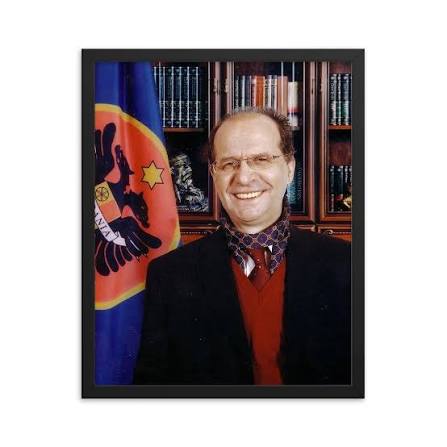
Faced with the apartheid imposed by Belgrade, Kosovo’s Albanian community initially opted for a strategy based on non-violence. Under the leadership of Ibrahim Rugova and the Democratic League of Kosovo (LDK), a fully fledged parallel society took shape: an underground system funded by voluntary contributions from the diaspora, self-managed medical clinics, and an extensive clandestine school network. In September 1991, a clandestine referendum sanctioned the proclamation of the first “Republic of Kosova”, formally recognised only by Albania. In 1992, Rugova was elected its president.
Nicknamed the “Gandhi of the Balkans”, Rugova pioneered what became known as “drawing-room diplomacy”. Lacking any formal state apparatus, he travelled constantly between Washington, London, Paris, Bonn and Rome, where he was received by the highest levels of Euro-Atlantic diplomacy — including US President Bill Clinton — not as a head of state, but as the moral authority of an oppressed people. This international profile culminated in 1998, when the European Parliament awarded him the Sakharov Prize: a distinction that formally established his standing as a political figure on the global stage, precisely as the non-violent strategy was beginning to reveal its structural limitations on the ground.
The Dayton Divide and the UÇK’s Armed Option
The real geopolitical turning point came in November 1995, when the Dayton Accords brought the Bosnian bloodbath to an end but deliberately ignored the Kosovo question, dismissing it as a purely internal Serbian affair in order not to jeopardise Milošević’s role as guarantor of the agreements.
Kosovo’s exclusion from Dayton convinced the younger, more radicalised segment of the Albanian population that Rugova’s passive resistance would never lead to independence. The Kosovo Liberation Army (UÇK) stepped in to fill the political vacuum, launching a guerrilla campaign against police stations and Yugoslav security forces. The insurgency received a decisive boost in 1997 with the economic and state collapse of neighbouring Albania, which led to the looting of state military depots and the uncontrolled influx of hundreds of thousands of small arms across the border.
The 1998 ACTORD and Italy’s Institutional Dilemma
The military intervention of spring 1999 was not a sudden reaction, but rather the culmination of a strategic posture deliberately adopted by the Atlantic Alliance as early as the autumn of the previous year. Faced with Milošević’s refusal to comply with UN Security Council Resolution 1199 — which condemned the humanitarian catastrophe but did not explicitly authorise the use of force, owing to the threat of a Russian and Chinese veto —, NATO opted for coercive diplomacy, a modern-day version of the nineteenth-century gunboat diplomacy. Accordingly, between 11 and 13 October 1998, Secretary General Javier Solana issued the operational activation orders (Activation Orders, ACTORDs), placing Allied air forces on 96-hour alert.
As far as Italy was concerned, the request to join the ACTORD came to Rome at a time of extreme institutional and political fragility. On 9 October 1998, the first government led by Romano Prodi had just fallen in the Chamber of Deputies. Having tendered his resignation to the President of the Republic, Oscar Luigi Scàlfaro, the government was now operating in a caretaker capacity (prorogatio), constitutionally restricted to the routine administration of current affairs.
The NATO request triggered a heated legal and political dilemma within the Council of Ministers on 12 and 13 October. Italy was the indispensable logistical and geographical hub for any military deployment across the Adriatic, providing key forward strategic air bases such as Aviano, Amendola, Gioia del Colle and Istrana. Could the granting of airspace access and military facilities to forces preparing for war be classified as an act of routine administration, or did it constitute a major political policy decision and an extraordinary administrative measure, beyond the remit of a government that had lost a confidence vote?
The Council of Ministers chose to give the Alliance the green light, basing its decision on a specific constitutional interpretation. On the one hand, adherence to the 1949 North Atlantic Treaty, ratified decades earlier by the Republican Parliament through ordinary legislation, constituted a pre-existing international obligation: implementing an agreement that had already been duly concluded represented a binding act of the State, rather than a new political determination. On the other hand, invoking the principle of continuity in state action and the need to safeguard national security in the Adriatic region, Palazzo Chigi concluded that an Italian procedural veto would have paralysed NATO’s operational credibility, exposing the country to serious geopolitical repercussions.
The ACTORD was temporarily put on hold thanks to the diplomatic mission of US envoy Richard Holbrooke, who secured Belgrade’s agreement to allow the OSCE verification mission to enter Kosovo. However, the formal precedent had been established: just a few days later, on 21 October 1998, the first D’Alema government was sworn in. It inherited that multilateral commitment and oversaw its definitive operational implementation in March 1999.
(End of Part One / to be continued)